
In the hours following the death of Turning Point USA’s controversial CEO Charlie Kirk at Utah Valley University, Governor Spencer Cox gave a statement condemning political violence. The Governor once again harkened to one of his trademark positions: a call for unity and civility, even, and especially, toward those with whom we disagree.
He listed the UVU shooting among other recent—apparently politically motivated—acts of violence, such as the attempts to kill the President and Pennsylvania Governor Josh Shapiro, as well as the murders of Speaker of the Minnesota House Melissa Hortman and her husband. But one need only look at the disparate and heavily partisan responses toward each of those events to see that many, even in Utah, do not hold the same value of “Disagree Better.”
Even in the immediate aftermath of the UVU shooting, whenever the conversation turned to Kirk, the topic of free speech was never far behind, and, as a result, the breadth of those First Amendment rights is being tested.
“Charlie believed in the power of free speech and debate to shape ideas and to persuade people,” said the Governor. “Historically, our university campuses in this nation and here in the state of Utah have been the place where truth and ideas are formulated and debated.”
Utah Valley University Vice President Val Peterson added, “We firmly believe that UVU is a place to share ideas and to debate openly and respectfully. Any attempt to infringe on those rights has no place here.”
Turning Point USA appears to have a different view of how the First Amendment should be applied on college campuses. On one hand, the organization has a platform because universities allow open discourse. On the other hand, Turning Point keeps a watchlist of professors whom it advocates to have fired for their beliefs.
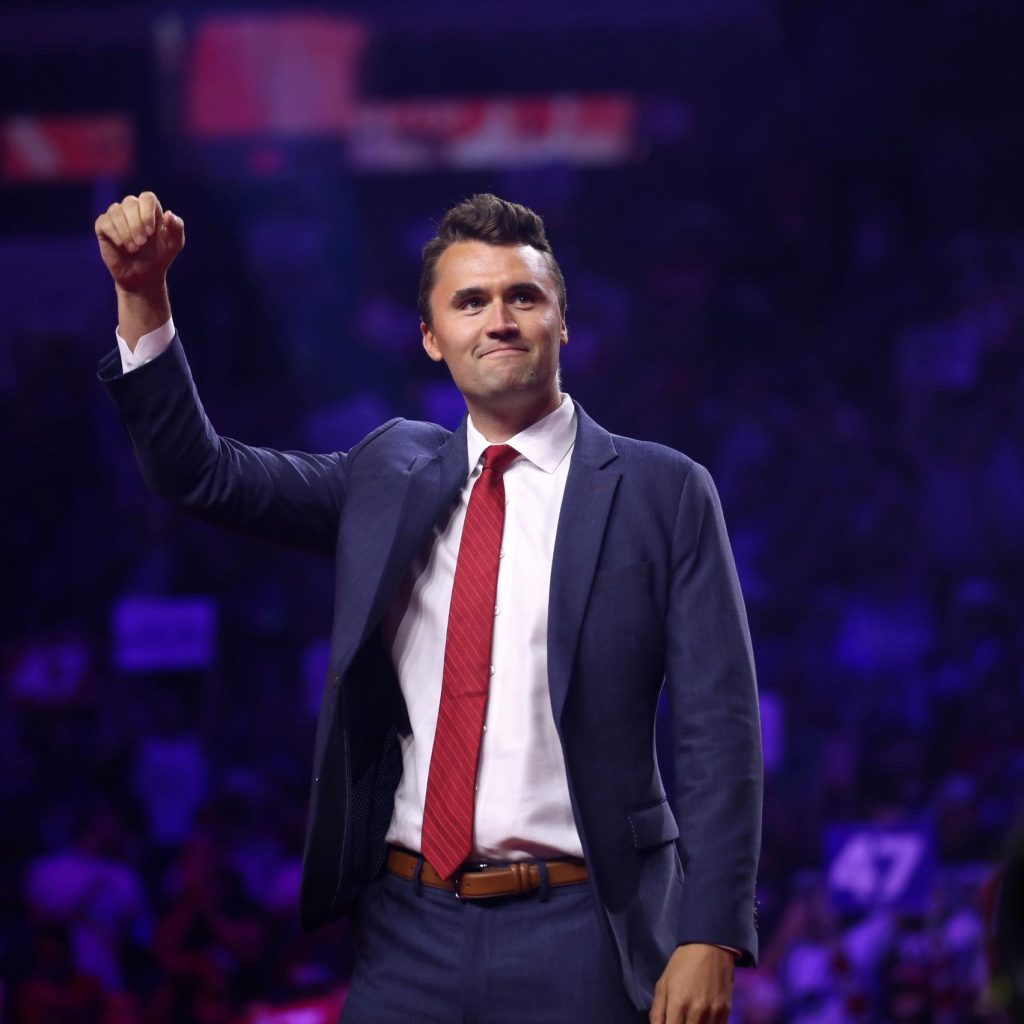
Photo courtesy Charlie Kirk/Facebook
Now the two converge. For the teachers and professors fired for sharing social media posts critical or disparaging of Kirk in the wake of his death, is the First Amendment on their side? According to the U.S. Attorney General, posts like that are considered hate speech, which she implied is not protected and stated overtly that the government would target those people. Never mind the U.S. Supreme Court decisions (recently in 2017, Matal v. Tam) that disagree. Now, the courts will once again decide on the extent of the First Amendment’s protections for disciplined educators and students.
Free Speech on Campus
The ACLU, which is involved in some of those lawsuits, holds the view that “Government officials calling for people who expressed their political views to lose their jobs or face other punishment is unconstitutional,” and to protect the free exchange of ideas, the ACLU seeks to defend educators and other public servants who face discipline for sharing personal views. In the past, the legal merit of such firings has hinged on whether the school can prove the speech itself significantly disrupted the school’s operations, but we live in interesting times.
It bears mentioning that the First Amendment protects people from government suppression. A private employer, or even a private university, therefore, is not likely to violate the Constitution when it fires an employee for posting something online. Public universities like UVU are different.
“When talking about First Amendment rights here, we’re really talking about public universities,” says Aaron Welcher, Director of Communications for the ACLU of Utah. Public institutions exist in a legal area similar to public streets, sidewalks, parks and other public spaces. However, even they are allowed to impose some limitations on how students and professors exercise their First Amendment rights.
“Students do have to comply with all applicable laws and university conduct codes—such as time, manner and place restrictions,” says Welcher. Universities must then apply those limitations consistently, regardless of the expressed message.
Welcher says they have seen, in the past, universities applying restrictions unevenly for some campus protests but not for others—most recently when some university students were encamped in support of Palestine.
“Universities have obviously misstepped when trying to limit free speech,” he says, but it’s the students’ responsibility to know those restrictions before planning any demonstrations or other free speech activities.
However, he adds, “Universities and college campuses should always err on the side of protecting the First Amendment—allowing students to be able to express themselves, even if they disagree with that speech.”
After all, isn’t challenging discourse and open dialogue fundamental to the college experience?
“That is just quintessential to what university and college campuses are supposed to be,” says Welcher. “They’re supposed to be these beacons of academic freedom. And part of that is for students and faculty to be able to learn from each other, share ideas and be able to express those ideas to each other—including letting those ideas be challenged.”
It should go without saying, but “When someone takes the life of a person because of their ideas or their ideals, then that very constitutional foundation is threatened,” said the Governor. So too, let’s not use violence as the justification for retaliation that threatens the very same constitutional foundation.
See more stories like this and all of our City Watch coverage. And while you’re here, why not subscribe and get six annual issues of Salt Lake magazine’s curated guide to the best of life in Utah?