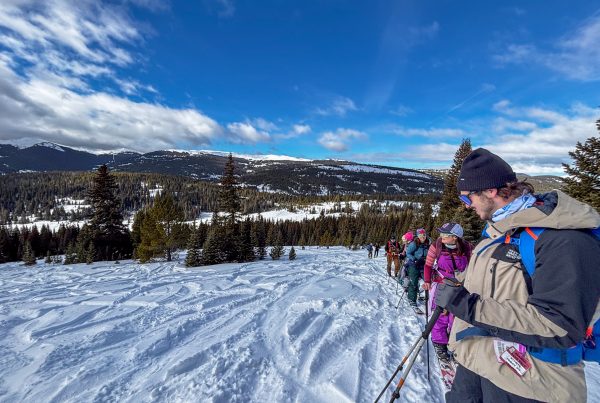
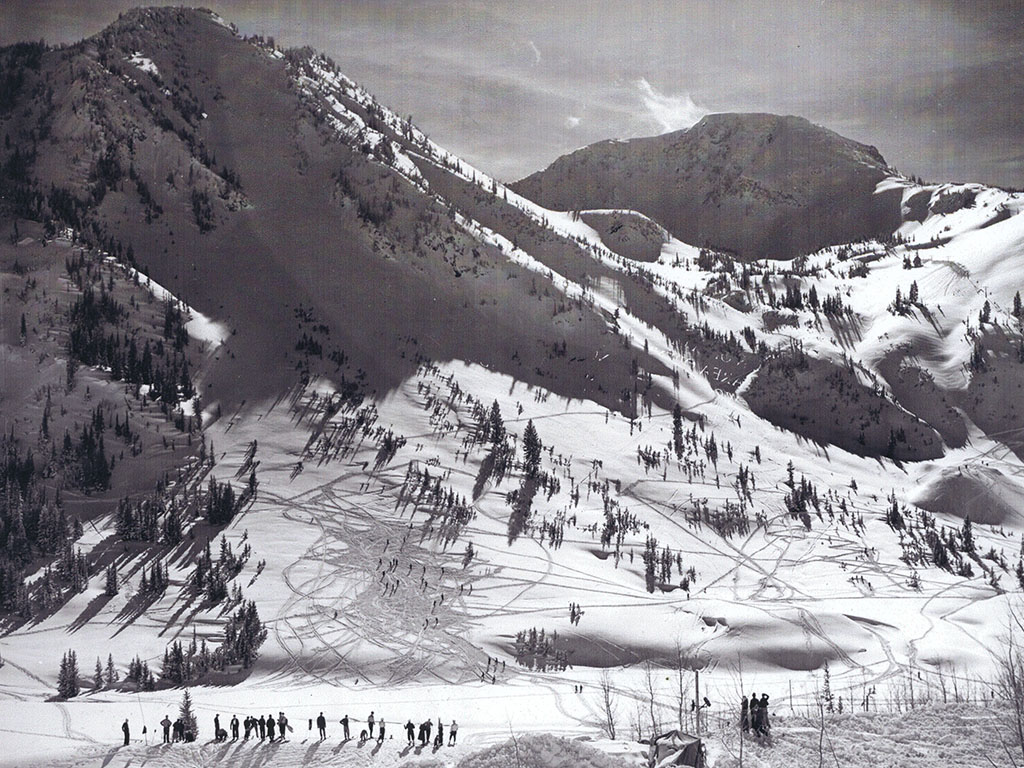
Today, we know Alta Ski Area for deep, unending powder and its challenging, steep terrain. But 160 years ago, that wasn’t the case.
In the 1860s, silver was discovered in Little Cottonwood Canyon. The first mining claim in Alta was established in 1965 and thousands of prospectors flocked to the area. They cut down trees to make homes and used them for firewood when winter came. Over the course of several boom and bust cycles, where the prices of silver rose and fell unpredictably, the forest and the township thinned.
In the Midwest, a prospector named George Watson and some friends were talking about heading west to take advantage of the boom. They drew straws to see who would go first to explore the area. Watson drew the shortest one.
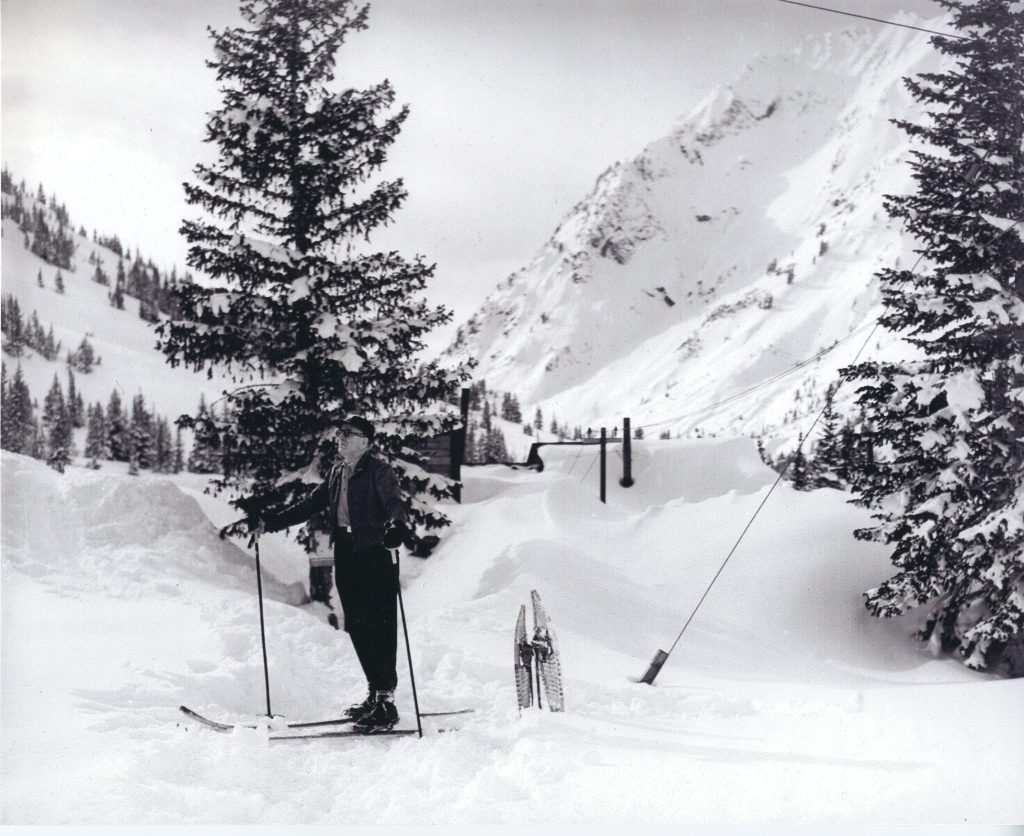
By the 1920s, the town was mostly abandoned, but Watson remained. Over time, he bought 80 surface rights to the abandoned silver mines for cheap. As the sole ghost town resident, Watson didn’t face much challenge when he humorously dubbed himself mayor of the Town of Alta. And while he didn’t find fortune in silver, Watson’s forward-thinking outdoors endeavors would eventually lead him to strike gold, white gold that is.
The Arrival of Alf Engen
Around that time, Alf Engen, a Norwegian ski jumper, immigrated to the United States with his brother. They settled in Chicago, Illinois and joined the American Norwegian Athletic Club. Alf’s son, Alan, later said he survived his first year only knowing two words: “coffee” and “donut.”
After he visited Utah for the first time to participate in a ski jumping competition, Alf fell in love with the Wasatch Mountains and permanently settled in Salt Lake City in 1931.
In 1935, he began working for the U.S. Forest Service as a technical advisor, overseeing efforts to replant trees that had been chopped down during the golden age of mining.
“Almost every tree you see up here is second-generation forest,” Dowdall said. “[Alf] was asked to identify some sites for winter recreation in the mountains around Salt Lake City. He toured around and he eventually landed on Alta.”
Alf eventually selected the land that would become Snowbasin, too.
“He just had this incredible knack for understanding what would make a good ski area, where the good snow fell, what aspects would make for some really incredible skiing,” Dowdall said.
After the land had been determined as a suitable site for winter sports, it came out that Mayor Watson hadn’t been paying his taxes. In a quick tax relief maneuver, he transferred the deeds to his patchwork of surface rights back to the Forest Service in 1937.
That allowed the Forest Service to found Alta Ski Area in 1938. What began with a few humble rope tows grew into the first single chair lift in Utah—the Collins lift. Per Alta’s High Rustler Lodge, it was made from pieces of a mining tram and logs and can still be found on display today at the Alf Engen Ski Museum in Park City.
Skiing, Lodges and the Alta Powder Technique
According to Alta’s Rustler Lodge, Mayor Watson predicted that “Alta will be reborn on skis.” He was correct.
Alf’s brother, Sverre Engen, helped Howard Stillwell, a man born and raised in Alta, build the original Rustler Lodge, which served as the resort’s first lodge. It opened in 1947 with one floor of guest rooms. Today, the venerable lodge boasts 85 guest rooms, outdoor jacuzzis, fine dining and a Swedish spa.
Meanwhile, Alf was working to establish Alta’s ski school, while also developing a method for skiing in Utah’s signature fluffy powder.
“European techniques weren’t as effective here in our snow,” Dowdall said.
Out of necessity, early Little Cottonwood Canyon skiers were tasked with figuring out a technique that helped them float through the deep, airy snow.
“Throughout the 40s and 50s, a lot of those techniques [were] developed right here at Alta,” Dowdall said.“
The Alta Powder Technique, which is now officially recorded in a not-so-official Google Doc, focuses on rhythm and flow for maintaining speed and buoyancy, while older European methods place more emphasis on edge control and angulation, which help with precise carving.
In the 1980s, one of the resort’s signature trails, Alf’s High Rustler, was named after Alf. The steep, advanced-level run is off Collins Lift and provides plenty of thrill to skiers each season. To many, the trail is a must-do while skiing Alta terrain.
“Alta is for Skiers” Because…
Some may assume that Alta’s skier-only policy is merely one of pride, but Dowdall said the rule was made with respect to the area’s history, terrain demands and guest preferences.
“Alta did actually permit snowboarding in the early phases of [its] conception, but our guests dictated what Alta did,” Dowdall said.
Much of the area’s terrain, which is served by only five lifts, is accessible by traversing uphill, which is notoriously difficult to do on a snowboard.
“It really makes sense to have two skis on your feet because so much terrain is … human-powered.”
This season, the resort is celebrating its 88th anniversary. Dowdall said they’re inviting people to grab a friend and carve synchronized turns into the snow (they’re referring to them as “powder eights”) in celebration of the area’s past and present.
Discover more Outdoor inspiration and find all our Adventure coverage. And while you’re here, why not subscribe and get six annual issues of Salt Lake magazine’s curated guide to the best of life in Utah?