
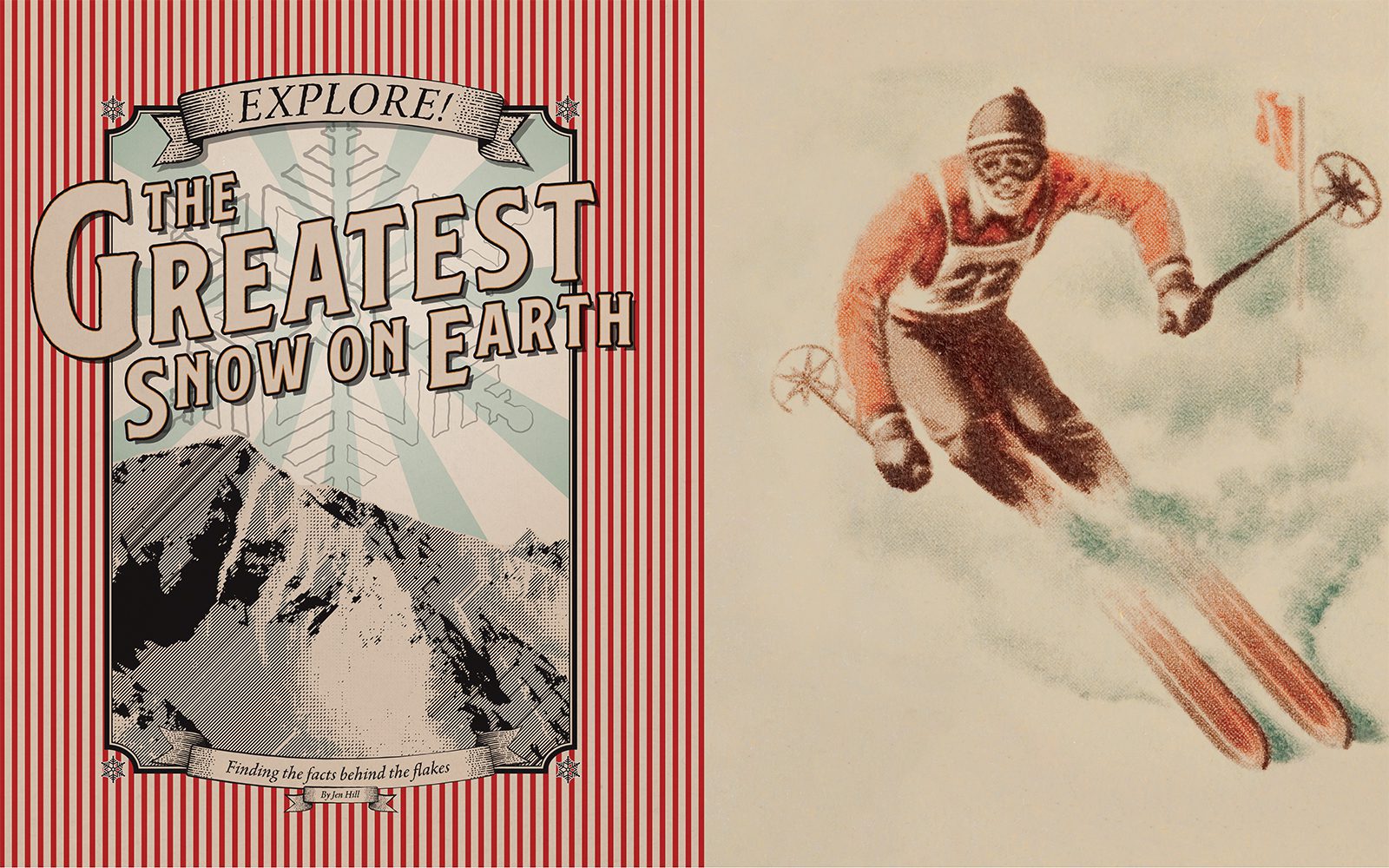
Utah has the Greatest Snow on Earth. So great we capitalize it and proclaim it on our license plates with an exclamation mark. Our great snow is not a myth. But why is Utah snow so great? And, considering how fast the natural world is changing, will it always be the greatest?
On Dec. 4, 1960, the Home Magazine of the Salt Lake Tribune coined the phrase “The Greatest Snow on Earth,” riffing on the Ringling Bros. and Barnum & Bailey Circus tagline. We all know that PT Barnum was the king of Blarney, but this Utah claim was actually true.
Before atmospheric science was a thing and shortly after the 1932 Winter Games in Lake Placid, NY, meteorologist and avid skier S. D. Green told a Salt Lake Tribune reporter that Utah’s snow and skiing were superior to Lake Placid attributing his claim to the “natural advantages” found here. Planting, possibly, seeds for the Utah Olympic movement.
But it wasn’t until weather forecasting technology advanced that scientists were able to really prove that, yes, Utah truly has the Greatest Snow on Earth. And, if you ski, you know the thrill of a Utah powder day, even more so if you’ve experienced East Coast ice sheets or West Coast “Sierra Cement.” Our great snow is not a myth—it’s a reality we experience every winter.

The Flakes
Snow is made up of millions of tiny flakes. To understand snow, you have to understand the flake, and we don’t mean ski bums in the bars. Most average American kids spend some classroom time folding and cutting out paper snowflakes. And any average American teacher probably mentioned that no two snowflakes are alike. Of course, it’s more complicated than that—Jim Steenburgh, professor of atmospheric science at the University of Utah, has devoted an entire book to the subject, Secrets of the Greatest Snow on Earth, making snow science approachable.
Snowflakes, Steenburgh says, aren’t (like you might think) frozen rain and they’re not usually individual snow crystals—the big, puffy flakes that fall when it’s just below freezing are actually bunches of crystals glommed together.

In cold weather, water droplets crystallize into symmetrical shapes around tiny pieces of dust as they fall. Charmingly, an individual snowflake’s shape is called a “habit,” a hexagonal prism, and scientists, predictably, have the varieties divided up into tidy categories. Six side facets form along the side and two side facets form at the top and the bottom. As it gets colder, the crystals change shape or habits; the more humid it is, the bigger the flake. Utah snow is a mad mix of these habits, growing at different altitudes and temperatures. They’re highly irregular.
Most Utah snowflakes are “defective, poorly formed, broken when colliding into other snowflakes, rimed or aggregated,” Steenburgh says. Utah snow is nothing like the elegant crystals in pretty habit diagrams that Steenburgh and his fellows draw and there’s no way you could ever cut a Utah snowflake out of paper. Utah snow is weird, a kind of Frankenstein’s snow (Frankensnow?) and, while no two snowflakes are alike, no snowflakes are like Utah’s.
The Great Lake Effect
Urban myths and half-truths swirl around like flakes when it comes to explaining just why Utah’s snow is so great—the lightest, the driest, the most powdery. You may have heard it’s because of our mountains’ proximity to the Great Salt Lake—the famous lake effect. If you’re really a snow nerd, you might have heard this described as “a unique orographic enhancement.”

The lake effect only accounts for about five percent of the annual snow in the Cottonwood Canyons. It occurs when the difference between the temperature of the relatively warm lake’s surface and the cold air above the lake is sufficiently large. When this difference in temperature is large enough, moisture and heat from the lake’s surface rise into the lower levels of the atmosphere and generate snowfall. Cool note: An extreme lake effect can cause thundersnow—snow showers with lightning and thunder.
How The Snow Falls
Besides the vaunted lake effect, Utah snow is great because of its water content—not a lot—and the pattern of its fall. Denser snow (with more water) is heavier and falls faster; lighter snow falls more slowly and has time to get more complex. Snow that’s less than seven percent water is considered light, and heavy is over 11 percent. Man-made snow is really dense, with an average of 24-28 percent. Dense snow creates an excellent base layer for skiing, sure, but you want the light stuff, powder, on the top. Snow in California’s and Nevada’s Sierra Nevada range is well over 11 percent water—hence the term “Sierra Cement.”
Utah snow, however, has an average density of 8.4 percent. The key to our amazing snow is a quick-change temperature fluctuation common to Utah snowstorms. Often a storm starts when it’s warmer, which creates a water-dense base layer, and as the temperatures drop, lighter snow follows. This is called “right-side up” snowfall (vs. upside-down). The fluffy stuff stays on top and skiers and boarders feel like they’re floating down Utah slopes.
Hopefully, right-side up.

From Greatest to not-so-great?
Global warming is being noticed most significantly in the Arctic, but Utah temperatures are warmer now than recorded just a few years ago. A cold winter in the early 21st century would have been an average winter in the mid-20th. Going even further into the past, looking at ice cores and tree rings, paleoclimatologists can figure out what the weather was like before humans were keeping records and even map out future climate scenarios based on the projected levels of greenhouse gases like carbon dioxide and methane.
“The role of dust is one that most don’t think about when it comes to the snowpack,” explains Steenburgh. Dense dust in the atmosphere creates something called “snirt,” brown and dirty snow. Like wearing a dark-colored knitted sweater, the sun’s light is absorbed by the darker snow rather than bouncing off a clean, white snowpack. One study found that snirty snow accelerates melting by 25 percent.
“Globally, snow is in decline and it’s not just from a warming climate—it’s more complicated than that. Snow is also getting darker,” says McKenzie Skiles, assistant professor of geography at the University of Utah.
As the temperatures rise, it doesn’t take a scientist to figure that more weather events will start as rain instead of snow, so we’ll have denser water-packed snow and our jokes about Sierra Cement suddenly won’t be funny anymore. The future isn’t rosy for snow sports.
And it’s also gloomy for those who don’t use the snow as a playground, but simply marvel at its quiet loveliness. As Steenburgh says, “The beauty of the snow is in the eye of the beholder and no science can prove that.”
The recipe for the Ultimate powder
The combination of these conditions creates the ultimate powder climate. Topography (big mountains) + Storm Temperature (warm to cold storms, right side up or hero snow) + Depth (at least 10-plus inches, enhanced by orographic flow and lake effect) + Frequency (Goldilocks Snow averaging every 10 days) = The Greatest Snow on Earth
10-plus inches of new snow allows flotation, so skis and boards do not ride on the underlying surface. With lesser amounts of new snow, we get “dust on crust.” The skiing looks great, but skis and boards sink and scrape into the underlying, crusty old snowpack. Utah’s climate supports more right-side-up snowfalls when storm temperatures start warmer (resulting in denser snow) and get progressively colder (less dense) lighter snow.
With even the smallest temperature increase, we can expect more rain and less snow, changes to our current storms and reduced snowpack. Add to that our famously dirty air and we have a problem.

Sounding Scientific: The Orographic Flow
Climatology meeting topography creates a snow-building phenomenon called
“orographic flow.” That’s the rapid cooling effect that occurs as the wind pulls clouds upward rapidly over a mountain. The wet air rises quickly and drops its moisture, which produces most of the snow that falls in our big mountains.

The anatomy of a snowflake
Tim Garrett, professor of atmospheric science at the University of Utah, captures three-dimensional pictures of falling snow with a multi-angle snowflake imaging system. The system gathers 3D images from three cameras with a common focal point placed toward each other from different angles. Extremely sensitive motion sensors detect a falling flake and snap a shot with a freaky fast 1⁄25K second shutter speed. With a matching set of cameras vertically placed above, like a traffic speed trap, the snowflake’s rate of speed can be determined.

The economy of snow. There’s gold in them thar flakes.
Either the first or second question someone who isn’t from Utah will ask you after learning you live here is: “Do you ski?” (The next, or first, query is always “Are you Mormon?”) The visibility of skiing in Utah is, in a large part the result of major marketing efforts from the Utah Department of Economic Development and Ski Utah, the marketing organization collectively owned by Utah’s 15 resorts. According to Ski Utah’s annual report, last season was the state’s second-best resulting in $1.32 billion in total visitor spending. Out-of-state skier and snowboarder spending ($1.068 billion) resulted in the creation of more than 21,000 total jobs and $226.4 million in state and local tax revenue. So skiing isn’t just a fun way to play on the snow, in Utah, it’s big business.
So what happens if the snow goes away? Resorts are responding with green initiatives from the token elimination of using straws and plastic to big deals like Alta’s planting 1,500 trees. In 2015, Ski Utah signed on with Protect Our Winters, a national organization that lobbies the governments at the state and local levels to address climate change (and melting snow) through clean energy and emission reduction policy.
The many words for snow
Cascade concrete or Sierra cement: Snow with the heaviest density (highest water content) occurs in Pacific states with mild temperatures and heavy snow depth.
- Wild snow or cold smoke, champagne powder or blower pow: Water content is less than four percent, temperatures are between -12 and -18 degrees Celsius and the spokes of the flakes are filled with air rather than ice.
- Goldilocks snow: Neither the densest nor the lightest, Utah snow’s water content averages the primo standard of about 8.4 percent. Not too wet, not too dry. Just right.
- Corn snow: Rough, granular surface snow occurs after alternate thawing and freezing.
- Riming: Water particles attach to snowflakes by filling in cavities between branches and arms, adding to the snow’s density.
- Graupel: Snowflakes completely coated by riming are graupel pellets, styrofoam-like snow that bounces off the ground.
- Man-made snow: Very dense, comprised of frozen water droplets, it can be a necessary evil.
- Diamond dust: Tiny, super-chilled snowflakes that glitter on sunny days.
Four reasons to ski here now
There are lots of ways to play in the Greatest Snow on Earth. Still, skiing and snowboarding are the main way we do it here in the Beehive. 11 world-famous resorts are less than a two-hour drive from Salt Lake International Airport, and four more through the state, brought 5 million visitors here last season. Maybe you should give it a try. Here are four reasons why it’s easier than it used to be and more affordable too.
No. 1: Easier Snow
In the old days, the rest of the mountain was left as nature intended i.e. difficult to ski. But now we have grooming. From the immaculate slopes of Deer Valley to the mainline runs at old-school Alta, (which recently bought the world’s first hybrid electric-gas snowcat for grooming) modern skiing isn’t trying to be difficult. “We know people are choosing where to ski because of the quality of grooming and the number of groomed runs,” says Park City General Manager Bill Rock.
No. 2: Better Gear
Think comfortable ski boots that feature a walk mode and, inversely, less-comfortable snowboard boots that bring some of the stiffness of ski boots to snowboarding to make it easier than ever to carve. Plus, the newest skis and snowboards use sidecut and rocker technology (think of the contour of a rocking chair rocker) that make turning—the key to going downhill on waxed sleds strapped to your feet—way easier.
No. 3: Better Lessons
“Beginners,” says veteran Alta ski instructor Scott Mathers, make two classic mistakes. One: “They let their friends teach them.” And two: “They don’t give it enough time. It takes more than one day to enjoy fully.” The concept of “terrain-based” learning is becoming the norm, it’s the primary focus of Woodward Park City, which opens this season. The method puts you on a deliberately designed course that features small doses of different mountain terrain. And lessons aren’t just for beginners anymore. Resorts offer clinics, tune-ups and refreshers for all ages and levels. At Mathers’ Alta, for example, women’s clinics turn into full-scale wellness retreats with yoga and spa time factored in. And for the kids, ski school now is also about teaching the parents to teach.
No. 4: More Terrain
Utah is home to the largest resort in the United States, Park City, but the real game-changer is the advent of multi-resort passes that have lowered prices for season passes across the board and offer more resorts to sample and find your groove.
Other ways to experience greatness on snow
Fat Bikes: A new trend from people who can’t ever sit still, these fat-tire bikes can travel across packed snow. Swap the beach cruiser for a snow cruiser.
Snowshoe: Explore the Night Owling Snowshoe Tour at Sundance Mountain Resort or Utah Avalanche Center tours in the backcountry.
Winter hiking: With all the traffic on local trails even in winter and especially Millcreek Canyon, snow gets packed down fast in the Wasatch making snowshoes unnecessary. Just strap on some YakTrax or other traction aids and walk on the packed snow. Bonus tip: Trekking poles or that spare set of ski poles you have lying around in the garage will help you keep your feet.
Related article: Utah Really Does Have the Greatest Snow on Earth