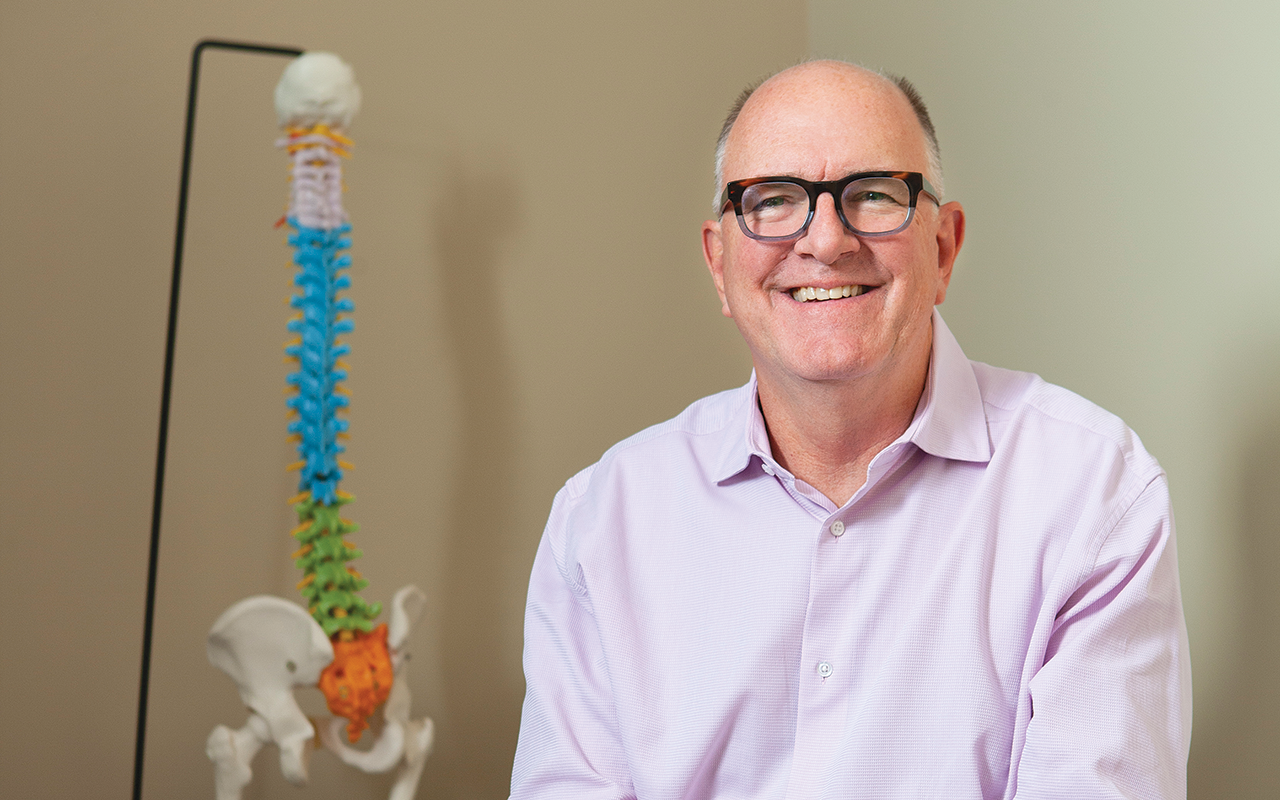
What does it mean to be a healthcare hero? To Dr. Joel MacDonald, it means a lot. “It’s a privilege to care for people—especially in my field, where patients often face life-altering and life-threatening problems, Dr. MacDonald, MD, FAANS, explains from his office at CommonSpirit Brain & Spine in West Jordan.
Patients who see Dr. MacDonald are usually suffering from serious ailments. The treatment process brings together both technology and the human touch. “Like most physicians, I chose this work because I sincerely want to help people,” he says. “Humankindness,” as CommonSpirit’s slogan reads on billboards all over the Salt Lake Valley, is combined with cutting-edge technology.
“Like most physicians, I chose this work because I sincerely want to help people.” -Dr. Joel MacDonald
“Treating a neurological ailment, like brain cancer or lumbar degenerative disease, is a team effort,” Dr. MacDonald says. You have to marshal all your resources to succeed. One of the most important resources? A commitment to a higher calling by a dedicated medical staff.
That’s what you find at CommonSpirit, Dr. MacDonald says, who also serves as the President of the Medical Staff at CommonSpirit Holy Cross Hospital, Salt Lake.
“We’re a faith-based organization focused on improving community health and prolonging life through clinical excellence,” says MacDonald. “Healthcare is fundamentally altruistic; our slogan encapsulates that mindset. We aim for humane care, optimal outcomes, and safety throughout the process, and we use that as a frame for every patient and every problem.”
A large expansion of neurological medicine treatments highlights Dr. MacDonald’s tenure at Holy Cross. Brain tumors, epilepsy, and Parkinson’s disease all fall within his area of special interest.
“Over the past seven years, we’ve built the foundation—investing in technology and extensively training nurses and staff…”
It didn’t happen overnight.
Building a program to bring neurosurgical capabilities to Holy Cross took a sizable effort. Now patients can receive care closer to their homes. Because patients can remain in their community for treatment, their family and friends can fill the practical roles like childcare and chores, and of course, emotional ones, like cheerleading during recovery.
“Neurosurgery diseases include spine disease, trauma, brain injury, tumors, epilepsy, movement disorders, and diffuse issues like pain and peripheral nerve injuries. Many of these problems weren’t managed here before,” Dr. MacDonald says. “Over the past seven years, we’ve built the foundation—investing in technology and extensively training nurses and staff. You can’t just say, ‘We’re open for neurosurgery.’ You need processes, equipment, and people with the right competencies.”
Now, many neurosurgical treatments happen in a part of the Salt Lake Valley that was previously underserved.
“For us, it’s been a long, ongoing effort, and we’re still adding capabilities and extending our reach.”
Spoken like a true hero.
Learn more from our partners. And while you’re here, subscribe to Salt Lake magazine to receive six beautiful print issues a year!