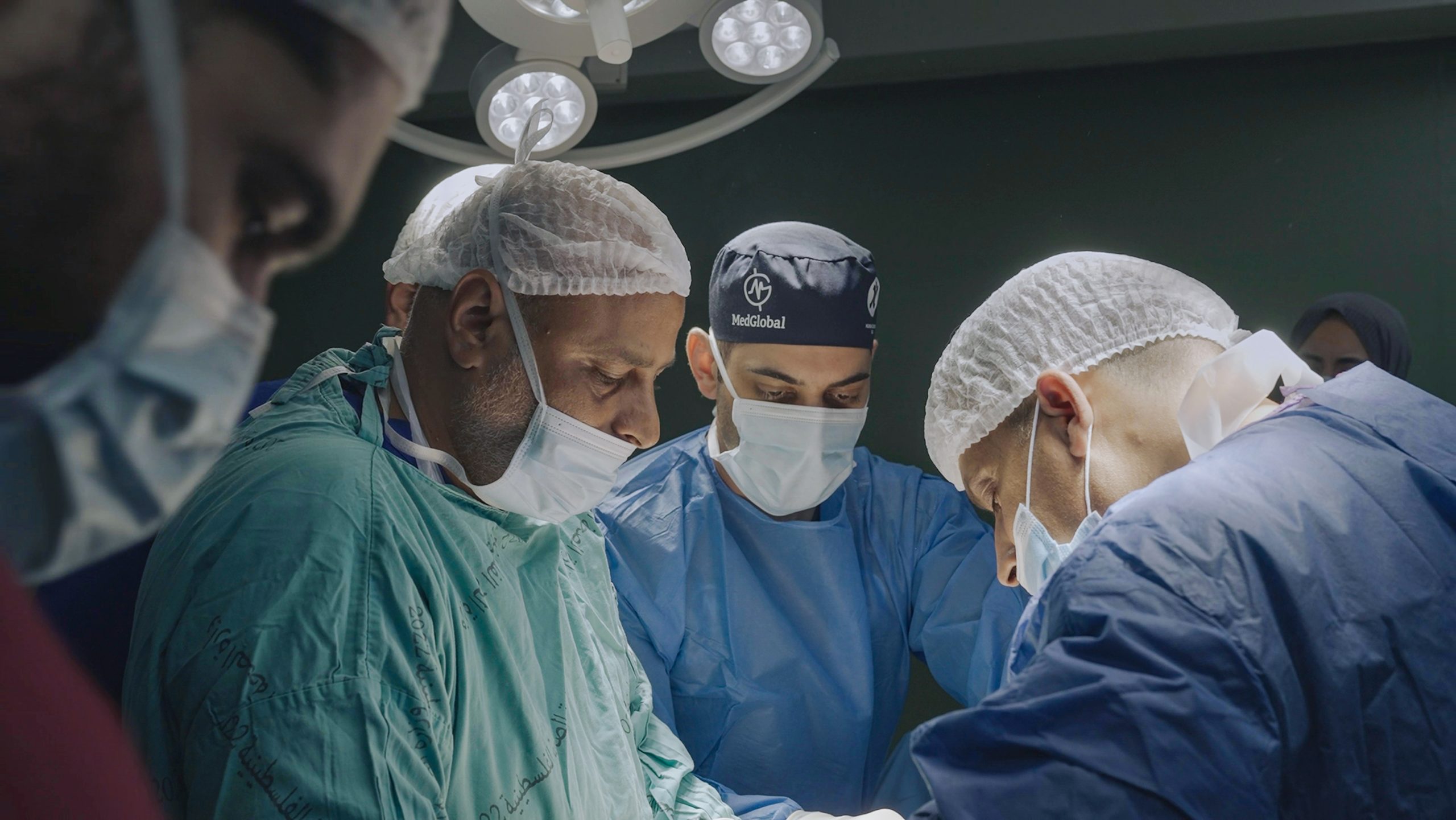
Directed by Poh Si Teng, American Doctor takes viewers directly into the middle of the humanitarian crisis in Gaza through the perspectives of three American doctors who volunteered to treat patients in the war-destroyed country—Dr. Feroze Sidhwa, a trauma surgeon, Dr. Mark Perlmutter, an orthopedic surgeon and Dr. Thaer Ahmad, an emergency physician. Through unfiltered, unblurred footage, it unapologetically depicts the devastation that has occurred as Israel has targeted civilians and bombed numerous hospitals.
One early scene in the film stood out to me: Teng sits with Perlmutter as he shows her photographs he took in Gaza—graphic images of dead and injured children. They’re discussing putting them in the film, but Teng is hesitant, suggesting that she may blur them out of respect for the victims. Perlmutter has a different view, insisting that documentary viewers need to see the full, unfiltered reality he’d captured, and that blurring the gory details is a disservice to those who have been impacted by the war. It appears that Teng was influenced by his points, as one of the images made the final cut, unedited. Given the broader controversy surrounding the conflict—and the role the U.S. has played in it—the moment raises a difficult ethical question: is blurring graphic images an act of respect, or simply a way of omitting factual information to keep Westerners comfortable and uninformed?
Controversially, the U.S. has given at least $16 billion to Israel since the attack carried out by the terrorist group Hamas ignited the war in October 2023. An intense global debate about whether or not Israel is committing genocide continues, as attacks on Gaza have killed an estimated 70,000 Palestinians, approximately 80% of whom were civilians.
Notably, Ahmad, a Palestinian-American who was born and lives in the U.S., has his efforts to gain entry to Gaza to volunteer his medical expertise foiled by the Israeli government, which is determining who can enter Gaza to render medical aid. According to press notes for the film, Ahmad was prevented from entering because of his Palestinian heritage. Scenes also show Perlmutter hiding medical supplies in his luggage in hopes of getting it across the border to help the war’s victims. Both of these clips explore the impacts that Israel is having on physicians who are merely trying to fulfill their Hippocratic oath to help the sick and injured.
American Doctor Scenes Depicted Horror, Closely Mirrored Dystopian Fiction
The film was impactful and at times, hard to watch, especially at the end, when the Nassar Hospital, where Thaer and Perlmutter had been helping before returning to the U.S., gets bombed. True to form, the film doesn’t omit any elements, from when the first explosive hits the side of the building to when a second goes off, injuring healthcare workers who were trying to move injured patients away from the wreckage. In a lot of ways, it reminded me of two scenes in The Hunger Games: Mockingjay Part II—one where Katniss is visiting District Eight and the hospital, full of innocent civilians, is bombed and a second scene when District 13 bombs a pen full of Capitol children twice, leaving just enough time between blasts for medics to rush in and help, ultimately maximizing casualties. From the most basic human standpoint, it’s devastating that something happening in the modern world so closely mirrors scenes from a dystopian fiction series. This section of the film is intercut with the following quote from Thaer:
“At Nassar Hospital, we saw what happened. How many times has that happened in Gaza? Somebody made that call, somebody made that decision. Somebody said here’s the green light, attack those hospitals. So the traditional protections that should be afforded to healthcare workers, first responders and journalists [are] gone out the window …but it’s not just about hospitals that are being attacked. its the erasure of that society, every aspect of life has been destroyed.”
American Doctor is a thought-provoking investigation into the horrors of war and the complex issue currently happening in the conflict between Israel and Hamas. Since the festival ended, there have been no reports of it being picked up for distribution by a major studio, but it should be. It’s a poignant watch for anyone looking to gain another perspective on this complex topic.
More from Mariah Maynes: The Last First: Winter K2 Recounts Fatal Race Toward Earth’s Second-Highest Peak, Warns of Dangers in Negligence
Read more of our Sundance festival stories and enjoy all of our Arts and Culture coverage. And while you’re here, subscribe to our print magazine and get 6 copies of Salt Lake magazine each year.