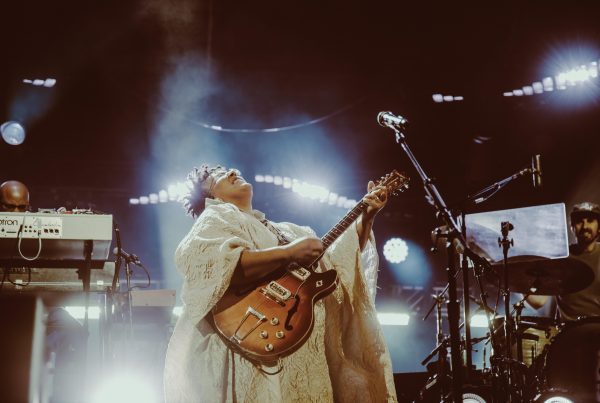

Marissa Nadler performs at Kilby Court this Thursday (April 2, 2026). Doors are at 6pm. Anand Wilder opens.
When I first heard Marissa’s music near the start of her career, it pulled me in immediately. Absolutely nothing and no one sounded like her. It was ethereal. Otherworldly. Transfixing. Getting a chance to catch up with where her journey has led after more than two decades performing allows a peek into how her process has evolved in a life dedicated to the arts.
When we spoke, she was at her home in Nashville, and she had a lot to share about her long career. Right away, though, she had a bone to pick with a certain rooster that couldn’t keep quiet the night before.
Q: How are you?
Nadler: “I’m a little tired because this rooster has magically appeared in our backyard. Every day at three until eight o’clock in the morning, it crows like crazy. And I’d never heard a rooster in real life before. It’s much scarier than what they say it should sound like.”
Q: Especially in the middle of the night, I’d imagine, when nothing else is going on.
Nadler: “It’s the strangest thing. He sits on the fence, right outside my window, and stares inside. I’m not usually someone who believes in revisitation in an animal form, but it’s starting to freak me out. I mean, who is he really?”
Q: I heard your music for the first time during the MySpace days, and I bought Ballads of Living and Dying(2004). What’s the journey been like since then?
Nadler: “That’s the first record I put out, my official debut. I’ve been at this all in for twenty-something years. It’s been rewarding. Choosing a full-time career in the arts isn’t easy, but it’s rewarding.”
Q: Was it always the goal to create a career as a musician?
Nadler: “I thought I’d be a painter. I went to school to be a fine artist and did music on the side. I recorded the first record while still in undergraduate school. When I got my master’s degree, I had two records out, and didn’t expect anybody to hear them outside of the small world of Eclipse Records, a very cool mail order record label. I got a job as an art teacher in Harlem, teaching 38 kids in one class, and was painfully shy. After getting an invitation to tour Europe, I gave my notice. It seemed better than washing paintbrushes and crying over the sink.”
Q: You started merging those worlds too, and painted some of your album covers, right?
Nadler: “Yeah, I did one of the album covers. I did the graphic design as well, and made all the music videos for this new record. So all the art training helped. I consider photography and painting to be very connected. I enjoy taking pictures and doing music videos in particular, because it’s creating a whole world for the music to live in, creating a cohesive aesthetic.”
Q: You created the video for “Hatchet Man” using, what, clip art?
Nadler: “Way cooler than clip art. I did the shots on an old opaque projector where I layered the foreground over transparencies and shot those, incorporating them with my drawings. I had to stop myself from getting too into animation, because it’s one of those pursuits that takes up all your time. I did one stop motion music video for “All the Colors of the Dark” in 2018 that took eight months of moving an inanimate object with photographs. It’s rewarding when it starts to work, but you have to take 1000 photos of the same thing moving slowly.”
Q: Tell me about your black and white aesthetic, which has continued through your career.
Nadler: “I love black and white. Almost everything looks better that way to me. Visually, I can see the composition much easier when color is not in battle with it. If I have trouble seeing if a photograph is good or not, I’ll change it to black and white. I do that when I teach art too, because it simplifies the image; a strong image should be strong in color or black and white. For the visual aspect of my career, it became something that matched, one less thing to worry about. It opens me up to focusing on the music more.
I love black and white films too. When I was in high school, my brother was in film school, and he showed me old movies. I got really into Jim Jarmusch movies, like Down By Law. Weirdly, years later, Jim and I are on the same record label, and we played a show together. He has a band called SQÜRL. He told me he really loved my photography. When I told my brother about that, he said, ‘Of course he does. Your whole aesthetic is rooted in me showing you these movies.’ I wouldn’t go quite that far, but I do like black and white. It’s classy.”
Q: It seems to tie into the timelessness of your music, which doesn’t seem to belong to any era.
Nadler: “I am influenced by the classic songwriters, and I create in a vortex or bubble. I don’t go out that much, so what I like may be a little old fashioned, but there are modern influences in terms of the production. If you dissected my songs, the structural elements could belong to any era.”
Q: I saw one of your most streamed songs is a Leonard Cohen cover?
Nadler: “Just on Spotify. I mean, hey, I’ll take it. The problem with Spotify is, as a career artist that has written 10 full length records and countless collaborations and covers, it’s problematic. The algorithm will say it’s my most streamed song. The Leave the Light On album has 27 million listens, but it doesn’t show up in the top five because it’s not one of my current top streaming songs. It’s frustrating. I’m not ashamed of that Cohen cover, but it’s 20 years old. I don’t even sound like the same person anymore. It’s infuriating that it won’t go away, because I identify more as a songwriter than an interpreter of other people’s songs.”
Q: But you’re a fan of Cohen’s?
Nadler: “I love his music. His writing in particular was a huge influence. His lyrics are not song lyrics. They’re poems set to music. When I dissect the lyrics, they’re just so beautiful.”
Q: He’s a guy who only got better as he aged, instead of the other way around. And you’re also a fan of Joni Mitchell. Your Pitchfork “Perfect 10” album was 1976’s Hejira.
Nadler: “I was so influenced by her guitar playing and gravitation toward open tunings. You can get bored always playing the same thing. Muscle memory puts your hands in the same place when you pick up a guitar. Change the tuning, though, and it can inform happy accidents. You can stumble on a voicing of a chord that sounds very differently because of that setup.
One reason she’s so fascinating: she got more jaded as she got older. She starts out with idealistic, romantic songs — that early 60s, flower child vibe — and, going into the Court and Spark era, she’s a different person. It’s like you can read her journals the whole way through. In this day and age, there is a bit of ageism. I still feel young, but I’ve been putting out records for 20 years. I often think, how does one avoid getting graded on a curve when they’ve been putting out strong work this whole time? Do I need to shave my head and do David Bowie songs? Reviewers need an angle sometimes.”
Q: A reinvention of some kind.
Nadler: “An example: the record I put out during the pandemic was so different from my other stuff, but sadly, because it came out when it did, it got tons of reviews, but people were checked out. The new record, on the other hand, is a return to my roots in some ways.”
Q: Does it feel like a full circle moment of a record for you, or not?
Nadler: “Yes and no. My brother said, sonically, it was in a conversation with my early work, which is such a writer thing to say. As for songwriting, I’ve become better with age. With structure, bridges, melody, lyrics, and hooks. A career artist is not going to have a full makeover every time they release an album. I consider my records a body of work I’m leaving behind. When I’m at the merch table and people ask which one’s my favorite, I can’t answer. Some of the early stuff, I don’t identify with anymore. Singers will go through phases of affectation when they’re young. I think: who on earth was I trying to be? With the last seven records, I’ve found my voice.”
Q: What was your pandemic record?
Nadler: “It’s called The Path of the Clouds. I was watching a lot of Unsolved Mysteries, the original one with Robert Stack as the host. Half the songs are based on true stories — unsolved mysteries — and they wrote themselves. There’s one about D.B. Cooper, one about the prisoners that escaped from Alcatraz, another about this couple that vanished on the Colorado River. I don’t know if I would have written that record had I not been holed up without the ability to go outside.
Recently, I’ve become interested in shipwrecks after seeing a map of how many have happened in the Atlantic Ocean. There’s so many. The ocean floors are a total graveyard.”
Q: You could go nonfiction or historical fiction with that kind of fodder.
Nadler: “I have a good handful of songs like that from that record. On an EP I put out, I wrote about the Queen Mary ship. There’s only so many songs about heartbreak you can write. I’m the queen of those, and I have so many sad songs in my repertoire, each one sadder than the next. Getting outside of your body and writing about totally different subject matter is fun. The newest record has a lot of those devices. Even though they are in first person, the starting points were real people, like the father of modern rocketry, or the first aviator that circumnavigated the globe. Exercises like that give you a jumping off point and get you out of that woe is me, confessional songwriting trope that so many fall prey to.”
Q: Listening to your catalog feels meditative. It has a pervasive calmness. Do you tap into that same kind of feeling as you’re performing?
Nadler: “More so now than I used to. I suffered from pretty debilitating stage fright in my early career. Now that I’m older it feels different. This tour, the turnouts have been a lot better than I expected. The last tour I did was right after the pandemic, so my perspective was skewed. So many people are coming to the shows, with almost full rooms across the board. As a cult musician that put the work in, that feels good. It’s easier to enjoy performing when you know you don’t have to win people over. I work the merch table before shows to break down this imaginary wall where I feel like I’m being judged. In reality, though, people want to see you do well. They’ve traveled from faraway, from several cities or provinces over. It’s not the era anymore where bloggers are going to concerts just to take you down. So I do enjoy it now. It is pretty mellow, and that’s the challenge. How do you put on a good show with such downtempo music and this many songs, when people want to hear songs from all the records?”
Q: How has your latest album felt different from those you’ve done before?
Nadler: “I produced it myself, without hiring an actual producer. The technology is so much better now that you can make stuff that is good enough to put out, without even soundproofing. When I started out in the MySpace days, every other dude would say I was using too much reverb on my voice, but things have changed. My partner Milky Burgess is on tour with me, and has been my main musical collaborator since Strangers (2016). I write all the songs, but he’s involved in the instrumentation and the arrangements, and has helped record. The biggest sonic difference on the new record is the amount of vocal arrangements and background vocals. I wanted to have an Everly Brothers background vocal, and the ability to add that was fun. I did go into a studio to track the main vocals, but to be able to demo at home is different. Some of the early records I did all on one mic in two days, with no overdubs. It has its own thing, but it’s also nice to be able to work on something for a while.”
Q: Did you record the early albums in the studio?
Nadler: “The first record was recorded by this boyfriend at the time who took every Wednesday off of work for an entire year, when I was a junior at the Rhode Island School of Design. He recorded it on a digital eight track machine with a zip disk, something they don’t even make anymore. The rest were in professional studios, although I like my demos as much as my professional recordings. I suffer from demoitis where I’m like, man, if only it sounded like my bedroom recordings.”
Q: Any advice for aspiring musicians?
Nadler: “One thing I think is important and sometimes lacking in the youngins — and it comes back to not growing up with the Internet — you need to put the time in. With Instagram and the instant gratification of likes and going viral on Tiktok, there’s often an unwillingness to dedicate yourself to a craft for almost an entire lifetime with no reward. If you look at some of these painters in history that died without ever being noticed, you have to wonder what kept them going. I believe it’s because of the sheer joy of the process. These days, everything is so reward driven. If you don’t get that carrot, what is the point of doing it? But young musicians need to learn not to expect too much too soon. That way, they’re making art for the right purpose. Sure, some are doing it for fame and fortune and want to be pop stars. There’s nothing wrong with that. But I’m a sucker for people that really are lifers and dedicated to a craft, continually refining it over time.”
Q: Did you learn a kind of resilience by not expecting anything in return?
Nadler: “Yeah. I certainly don’t expect anything now. There was an era in my life where I was and I was always disappointed. This may sound dark, but if you expect the absolute worst in what could possibly go wrong, you’re never disappointed. You’re surprised. I try to keep expectations low, except for myself. I’ll know if I spent a good amount of time on a song. When I was working on the lyrics for this last one, my brother said, ‘Just interrogate every noun, every verb, every adjective.’ I did that, and I think it shows. There’s a science fiction tinge to it, because a lot of the songs take place in spaceships or in the sky or in other galaxies. I still like writing after all these years. The minute you stop enjoying it, you should take a break and do something else.”
Q: What’s next for you?
Nadler: “This tour will go until mid-April, and I have a side project that hasn’t launched yet, a band I’ve put together where I’m just singing, along with Milky and this man from Tangerine Dream. It’s very cinematic. We’ll share songs from that, and probably write another album. I want to get fine art gallery representation for my paintings, too. I’m very ambitious in terms of art, but I will continue teaching art at night when I’m not on tour, because it’s a great way to keep your head out of the clouds and hang with real people that aren’t in the music industry. If I can teach a 90-year-old man how to paint again, that’s way better than a good review for me.”
Read more of our Music coverage and get the latest on the Arts and Culture scene in and around Utah. And while you’re here, subscribe and get six issues of Salt Lake magazine, your curated guide to the best of life in Utah.