
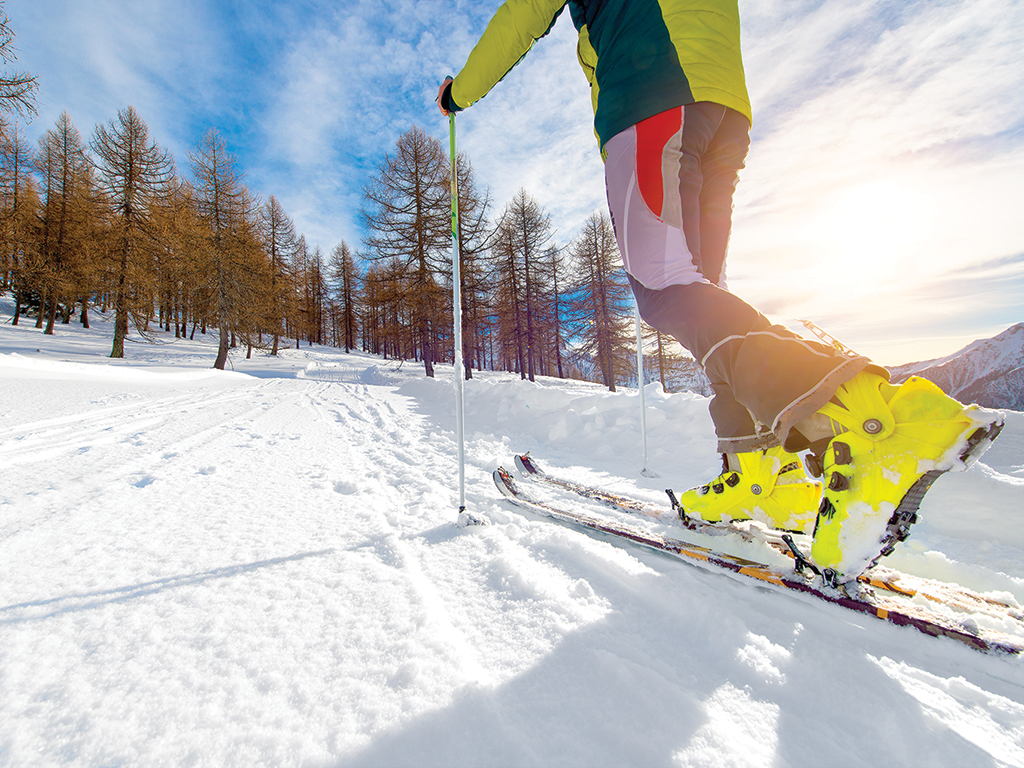
You might have seen this phenomenon after the chairlifts stop running: A pack of skiers out on the resort slopes, with headlamps, going up instead of down. Uphill skiing, also called skinning, is both a workout and a way to enjoy the slopes at no cost—after all, what goes up must come down.
But it’s not as simple as pointing your skis toward the top of the mountain. There’s a technique to doing this well, and the skills you will learn aren’t just for climbing the groomed slopes. They also work for anytime you might want to ski out of bounds. It pays to spend a little time on the groomers perfecting those critical backcountry skiing skills, like kick turns and transitioning. So says ski mountaineering athlete, founder of Silverfork SkiMo (silverforkskimo.com) and USA SkiMo Head of Sport, Sarah Cookler. “It just makes for a more pleasant experience in the beginning if some efficiencies are learned and practiced beforehand in a more controlled environment, like on groomed resort runs,” she says.
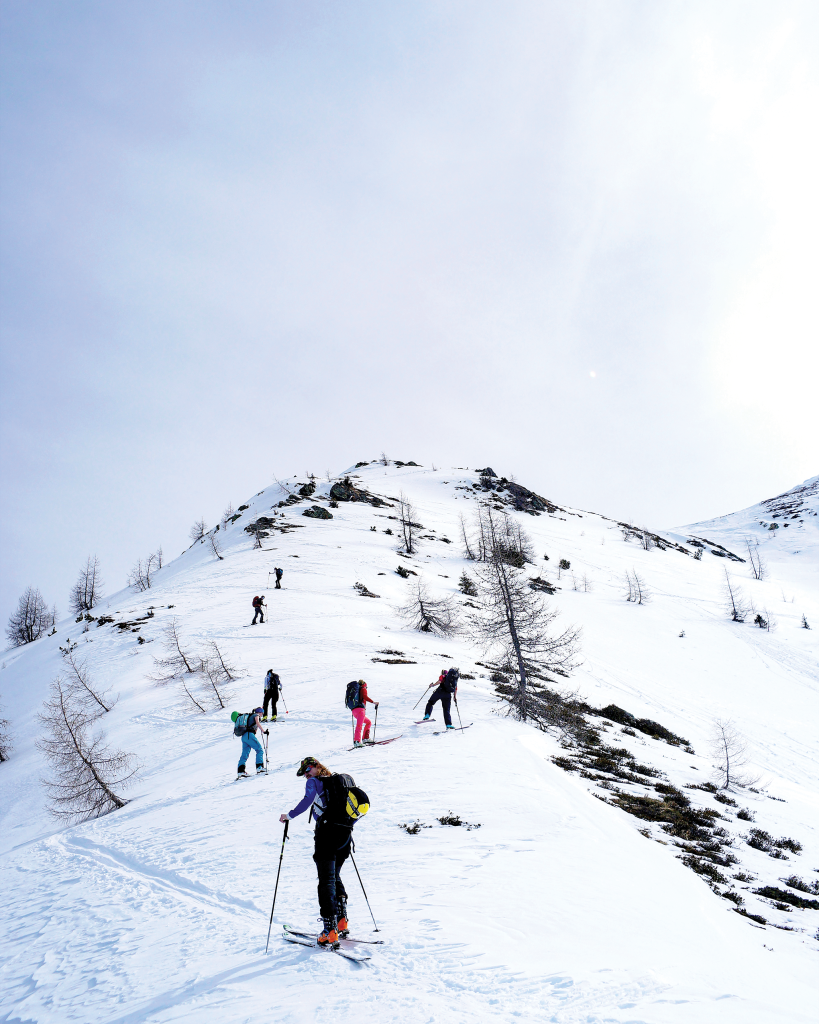
The key to skinning, Cookler explained, is always keeping the entire bottom of your ski in contact with the snow. Instead of picking up your feet to make your way uphill, a la hiking, engage both your quads and your core to slide each alternating ski up the slope. Practicing this without poles will emphasize using your core to maintain balance. “Instead of just heading straight up the hill along the fall line, practice going diagonally along the hill to build ankle stability,” she says.
When you do add poling back in, work on aligning the toe of your uphill-moving, front ski boot with your forward arm’s pole-plant while leaning forward to maintain momentum. “Overreaching the pole plant is a good way to decelerate and use too much energy,” she says.
The kick turn—a move required to round a switchback—is one of the hardest ski touring skills to master. Techniques Cookler recommends for consistent and efficient kick turns are this: make a half-slide past the end of the downhill switchback before kicking and moving your uphill ski over to the opposite switchback; and when you’re ready to make the kick, which is intended to lift the shovel, or toe-end, of your uphill ski up and over the snow surface, keep that uphill leg straight as you lift it behind you and then kick. This creates the flick you need to get the shovel of the ski clear of the snow and easily over to the opposite skin track. “The best advice I can give here is repetition and, again, practicing it without poles will really help you nail it,” Cookler says.
Personal preference rules the order of operations for transitioning or switching from uphilling to skiing. But the step-by-step process Cookler teaches her athletes is “Put your poles down, place your boots in ski mode, rip (remove) your skins, click into your rear bindings, grab your poles and go,” she says. “This sequence works well for skimo skis, where the skins are attached only at the tip of the skis. Find a sequence that works for you and your particular gear and practice it.”
While there’s certainly much more to learn once newbie ski tourers step into the backcountry, investing in a few days of inbounds prep can make the difference between, as Cookler put it, “holding up the rest of the group or freezing while you fumble through a transition, and sipping your tea while you wait for your friends to catch up to you at the top of the skin track.
Resorts for Backcountry Skiing Practice
Thanks to the thoughtful peeps at the Utah Avalanche Center (utahavalanchecenter.org), most aspiring backcountry skiers and snowboarders are aware of the safety-related boxes they need to check before heading into the backcountry, including taking an AIARE Level 1 or equivalent course. But once you get your alpine touring setup, rather than bee-lining it from the chairlifts to the out-of-bounds goods, here’s where you can practice your skills on groomed slopes:
Brighton Resort: Great Western and Millicent 4:30 p.m. to 8 a.m. Check the conditions page for current status.
Park City Mountain: Homerun from the bottom of First Time to the Angle Station, 6 p.m. to 8:30 a.m., beginning in mid-December, conditions permitting. For details, visit the resort’s uphill travel policy page or text “uphill” to (435) 244-1769.
Solitude Mountain Resort: Sunrise area, 4 p.m. to 10 p.m. Free uphill travel pass required. More details on the resort website.
Snowbasin: various designated routes, 4 to 8 a.m. and 9 a.m. to 3 p.m. Free uphill travel pass and free daily uphill ticket required. Check the conditions page at snowbasin.com for current uphill status.
Powder Mountain: on Lefty’s Ski Canyon, James Peak, Lightning Ridge and Baldy during open hours only; lift ticket or pass required. More details here.
Beaver Mountain: allowed on designated routes with a Winter Uphill Access Pass. Visit the uphill traffic policy page for more information.
Cherry Peak: allowed daily from 4 a.m. to 8:30 a.m. Get current uphill travel status on the Mountain Conditions Page at skicpr.com or by calling (435) 200-1234.
Eagle Point Resort: on Big Horn run, details here.
For a complete list of Utah resort uphill policies, visit the UAC website.
Discover more Outdoor inspiration and find all our Adventure coverage. And while you’re here, why not subscribe and get six annual issues of Salt Lake magazine’s curated guide to the best of life in Utah?