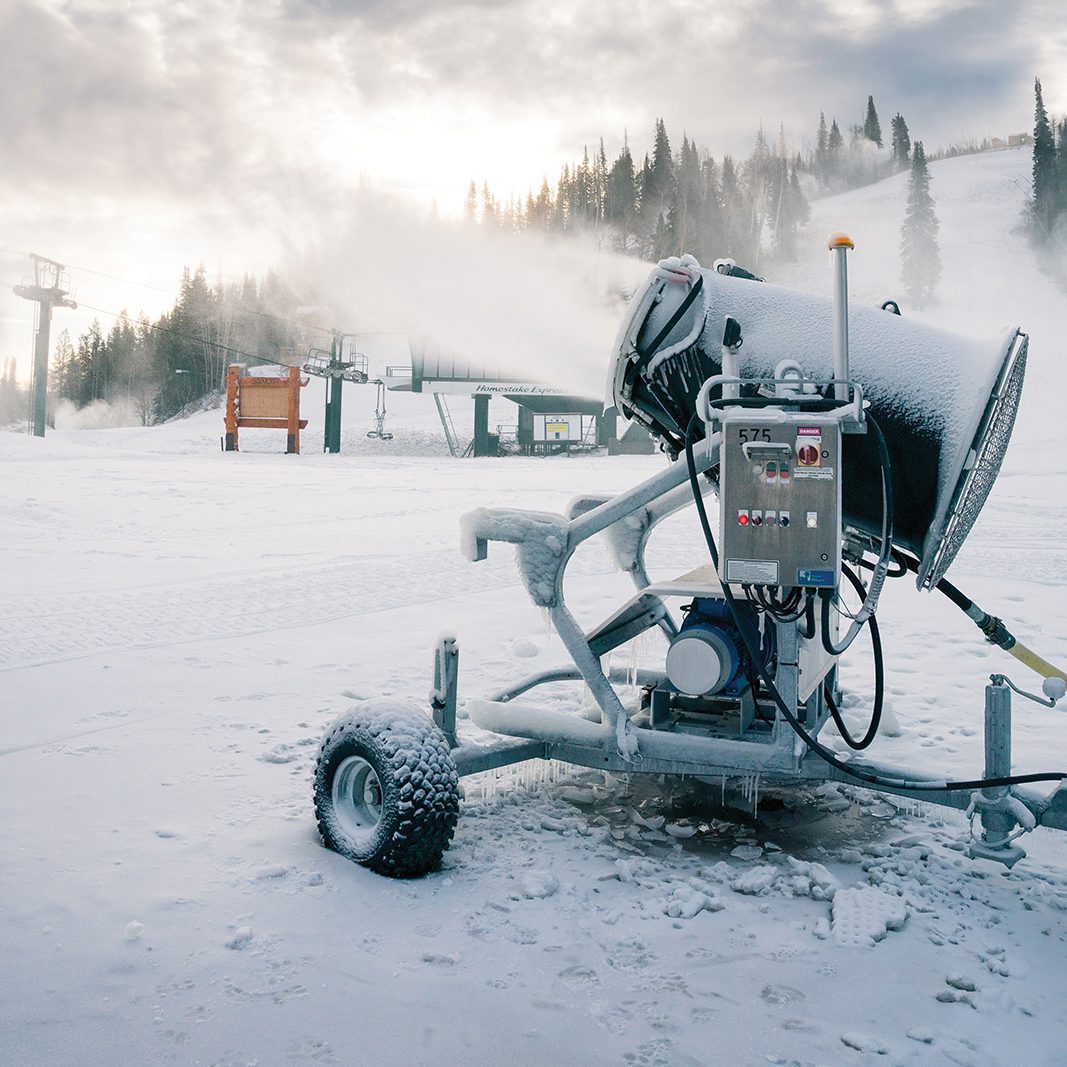
Staring between my ski tips dangling from the chairlift at a disordered pack of skiers zigzagging down a narrow run, I noticed how loud my skis’ steel edges sounded as they struggled to gain purchase on the firm snow. It was early December, and open terrain consisted of a single white ribbon. Typically, the overwhelming din of blazing snow guns supplementing the dearth of natural snow would drown out all other noise, but temperatures weren’t cold enough to run the snowmakers. Things were getting dire in the Utah mountains.
Early season conditions can be fickle, even here in the land of the Greatest Snow on Earth. Still, ask around the bar stools where the crusty locals post up, and they’ll tell you warm temperatures and early season droughts are more common. Sure, they’re pining for the glory days, but they’re not wrong. According to a 2021 Utah State University (USU) Institute of Outdoor Recreation and Tourism (IORT) study, the average minimum daily temperature at Utah ski resorts has increased an average of 2.6 degrees Celsius from 1980 to 2018. It’s no secret to resort managers who’ve invested heavily into snowmaking infrastructure to bolster the early season, but is snowmaking a reliable long-term solution?

While locals know the best conditions come in the second half of the season, the early season—and the holidays in particular—is enormously important for overall season profitability. Resorts are working to enhance snowmaking capabilities to protect that crucial period.
Deer Valley Senior Communications Manager Emily Summers said even though the resort has 250 snow guns, 40 miles of pipe and 1,150 hydrants, the resort invested more than $1 million in snowmaking infrastructure and equipment this year alone. For this story, Summers tried to schedule an interview with a member of Deer Valley’s snowmaking team, but they simply were too busy making snow ahead of the holiday rush.
Other resorts are following suit, but it might not be enough in a warming climate. “The percentage of the ski season where we can actually make snow is rapidly declining,” says Dr. Patrick Belmont, Watershed Sciences Department Head at USU. “Generally without using additives, you can’t [make snow at] temperatures much above 23 degrees Fahrenheit.”
The additives Belmont is referring to are known as “nucleating agents,” tiny grains of biodegradable bacterial protein—the common brand name is Snomax—expelled with pressurized water to facilitate ice crystal growth. Using these additives substantially increases snowmaking costs, which at a certain point could become prohibitive. Although resorts don’t release specific figures, snowmaking is also incredibly energy-intensive. “For a lot of resorts with extensive snowmaking, it accounts for a majority of their annual power consumption,” veteran snowmaker Tim Valcourt says.
We haven’t even addressed the fact that all snow starts as water. “Utah is the second driest state in the nation, and we’ve been treating snowmaking as a non-consumptive activity,” Belmont says. “But even when water is pulled from reservoirs rather than groundwater, it’s reducing groundwater recharge, and a decent percentage—15% to 40%—evaporates or sublimates. Reservoirs around the state are getting pretty empty.”
The Catch-22 is that more snowmaking will be required with a warming climate, while the conditions and resources required to make snow are also vanishing. Resorts, while avoiding chicken little proclamations, are quietly adapting. The USU IORT study’s authors interviewed numerous resort managers who say they’re diversifying offerings with more off-season infrastructure like mountain biking in the summer.
In the short term, snowmaking may be able to pad season length. Even so, it may not be able to save the ski economy. In statewide analyses, the USU IORT study found winters with high levels of snow contributed an additional $49 million to the state economy while low-snow years resulted in a 7% decrease in skier visits and more than $50 million in losses to the Utah economy. Call it the backyard syndrome. When it snows people go skiing. When it doesn’t? They don’t.
Snowmaking alone can’t save us. Protecting future ski seasons will require systemic change that appears very difficult in today’s social climate. “The only thing that matters right now is how quickly we get the fossil fuels turned off,” Belmont says. “The pollution we’re putting in the atmosphere is the problem and climate change is the symptom. We perceive this as a problem of politics and economics, but ultimately it’s physics, and the physics are unforgiving.”
For too long we snow lovers have had our heads buried in the snow when it comes to facing these issues. That’s going to become a lot harder when all that’s left is human-made hardpack.
Read more about the Utah outdoors in all four seasons. Subscribe to get more Salt Lake.