
Fifty years ago, Neil Armstrong took his one small step. (For a thrilling account of how it went down, or actually, up, see Apollo 11 which premiered at the 2019 Sundance Film Festival on opening night.) As well as Cape Canaveral and Houston, Utah from the Space Dynamics Laboratory to the Green Beam, contributed to the giant leap for mankind, the moon landing, yeah that one, and other U.S. space endeavors.
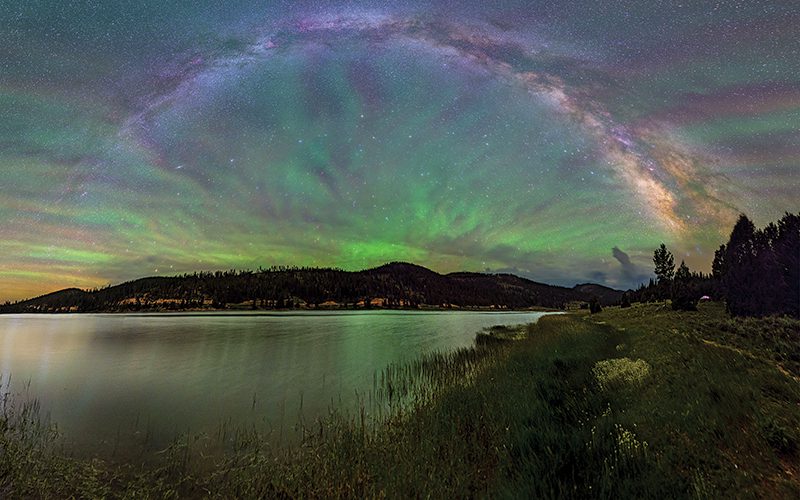
Shooting Stars Space travel began when humans first looked up into the night sky. Utah offers access to more dark sky than anywhere else in the country and we’re encouraging more, helping all the movers and shakers understand the value of dark skies and the problem of light pollution. Dark skies mean Utah’s a mecca for astro-photographers—David Lane and other astro-photographers flock to Bryce Canyon; the park holds regular astronomy and photography workshops. nps.gov/brca
Nerds Were First Space Dynamics Laboratory a nonprofit research corporation operated by USU, was founded in the era of pocket-protectors, just as U.S. Space programs really got off the ground. Since then, Space Dynamics Laboratory has created sensors for more than 400 payloads ranging from aircraft to rocket-borne experiments that traveled in the Space Shuttle and to the International Space Station.
The Center for Atmospheric and Space Sciences at U.S.U. aims its famous “Green Beam,” a sophisticated LIDAR, or light laser, at the upper reaches of our atmosphere. CASS is figuring out how to determine what space weather is like because it can interfere with human space missions—like satellites, communications systems and GPS accuracy. Space weather is a result of solar storms.
The Airglow It sounds like a hippie’s acid dream, but airglow is a real thing being studied at—where else?—USU NASA chose the school’s Atmospheric Wave Experiment (aptly dubbed AWE) to study airglow from the International Space Station. USU physics professor Mike Taylor has studied atmospheric gravity waves for decades. He’s leading the project which will mount a camera on the ISS to capture airglow images, colorful light bands caused by planetary atmospheres to explore forces driving space weather. Lift-off: August 2022.
Subscribers can see more. Sign up and you’ll be included in our membership program and get access to exclusive deals, premium content and more. Get the magazine, get the deals, get the best of life in Utah!