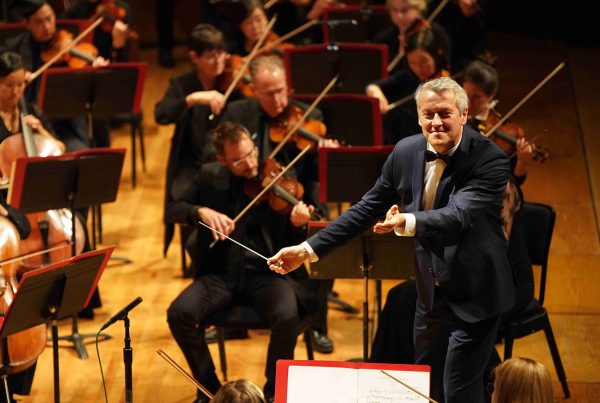

“Excellence is not something set in stone. Excellence is simply doing the very best we have,” says Utah Symphony Music Director Thierry Fischer. Fischer, a Swiss conductor who has been with Utah Symphony since 2009, has ushered the orchestra into a new era guided by this philosophy, one that’s both exacting and open to creativity and exploration. During his tenure, he has not only led the orchestra through tumultuous times, including a bruising recession and global pandemic, he has recorded new material, championed contemporary works by American composers and expanded the symphony’s reach. Now, Fischer is bidding farewell to the Utah Symphony—the 2022-23 season will be his last as conductor.
Fischer began his career as a flutist until he was suddenly asked to replace a conductor who had fallen ill. Call it kismet, a happy accident or whatever you choose, but that one last-minute opportunity permanently altered his career. “After that first rehearsal, I knew my life had changed radically,” he said in a 2010 interview with The Salt Lake Tribune. “There was a strong belief in me that this was it.”
Over the years, Fischer worked as a conductor in Amsterdam; Belfast; Nagoya, Japan and Cardiff, Wales. Before his tenure in Utah, Fischer had already felt a connection with the symphony through legendary conductor Maurice Abravanel’s recordings. “The orchestra had a sense of history,” he explains. “The work they did with Maurice Abravanel was an example all over the world and known everywhere.” Abravanel led the symphony for more than three decades and shepherded Utah Symphony from a brand-new professional organization to an orchestra of national renown. This musical legacy attracted Fischer to the position. “I wanted to do my bit, helping the orchestra and the organization to reach a step further,” he says.
It may be a daunting task to take over an orchestra of 80-plus professional musicians, but for Fischer the connection seemed innate. “This is very natural,” he says of the relationships he established with the musicians. “You know, we play music,” he adds with a laugh. Fischer says that some details of the largely unspoken connection between conductor and orchestra took years to develop. The foundation, though, was strong from the beginning. “It’s never an issue to create a relationship with a group of motivated musicians, I think. Everything went through very naturally, very organically,” he says. “We all want to have beautiful, deep sounds. We all want to take risks. We all want to create the utmost fragility.”
An always-present challenge for the symphony’s leadership is bringing in new audiences who are not accustomed to seeking out classical music. One of the most creative solutions of the Fischer era? A 2014 “road trip” to all five of Utah’s national parks. “Utah is one of the most beautiful states in America,” he says. “Let’s go into nature. Let’s be inspired. Let’s put all the beauty together.” The tour was a great success, inspiring another 2017 series at six iconic Utah landmarks. Beyond the novelty of performing in these unique venues, Fischer wanted to reach people who, for whatever reason, weren’t buying tickets to Abravanel Hall. “Let’s go where people are,” he says simply, embracing the idea that the orchestra’s art is for everyone.
Perhaps the best illustration of Fischer’s ambitions is Utah Symphony’s 2015-16 season, which marked the orchestra’s 75th anniversary. To celebrate this milestone, Fischer conducted creative collaborations with other legacy arts organizations in Utah. The symphony performed Gershwin, Debussy and Ravel with Ballet West. They traveled to Utah Shakespeare Festival, where actors performed selections of Shakespeare’s Romeo & Juliet and the orchestra performed R. Strauss Prokofiev’s composition of the same name. They shared the stage with singers from Utah Opera, Madeleine Choir School and The Tabernacle Choir at Temple Square.
The season culminated with a performance at Carnegie Hall. Presenting the New York premiere of the inventive percussion concerto Switch by Andrew Norman, this was Utah Symphony’s first appearance at Carnegie Hall since Abravanel’s tenure 41 years prior. The performance, a validating signal of Utah Symphony’s national stature, was reviewed positively in The New York Times. “It was very, very special. I’m sure everybody remembers everything. I certainly do,” Fischer says.
Fischer will conclude his time as Music Director by conducting Gustav Mahler’s Symphony No. 3, an epic classic that Fischer calls “a hymn to love.” Typically running more than 90 minutes, this wide-ranging work’s celebration of nature, spirituality and beauty is a fitting finish to Fischer’s artistic journey at Utah Symphony. “This symphony is about everything and making connections to all different kinds of life,” he says. Fischer’s career in Utah has given him plenty of reasons to celebrate, but he is not one to rest on his laurels or dwell on the past. “It is impossible to say that we achieved anything,” he says, “because the best is always in front of us with music.”
Utah Symphony will kick off their season with a gala celebrating Fischer on Sept. 8. For more information on their 2022-23 season, visit utahsymphony.org.