Less than twelve hours after the four best male tennis players in the world competed for over nine hours in two grueling, dramatic five set semifinals at the 2026 Australian Open, in Melbourne, Liz Garbus’ Give Me the Ball!, documenting the life and career of arguably the most famous American female tennis player of all time, made its Salt Lake City premiere. It’s a fun and deeply resonant film that demonstrates that sport is always more than the score and that the appallingly ignorant “shut up and play” mentality circulating throughout our wretched media space not only violently dismisses the humanity of athletes and the civic responsibility they share with us—because they are us—it also ignores the significant, broadly relevant inspiration sport can impart, even if we’re just watching from the couch.
This year’s Australian Open singles champions, both female and male, will each receive almost $3 million in prize money. The female and male runners up will also receive equal prize money, as will all players who were knocked out in the first round. Billie Jean King, the subject of Give Me the Ball! is considered to be largely responsible for this equity, having successfully used her fame to push the US Open to be the first of the four Grand Slam tournaments to pay women and men equally in 1973. Already the highest earning female player in the world, and winner of multiple grand slam titles (including three straight at Wimbledon from 1966-68), King earned just $10,000 for her 1972 US Open title (her third of four), compared to $25,000 won by that year’s men’s champion, Ilie Nǎstase.
King had had enough. She threatened a boycott.
In her telling, she made her move impulsively in a post-match press conference, suggesting that she and other female players wouldn’t play the 1973 US Open without equal pay, though she hadn’t yet consulted any of the other players on the women’s tour she’d co-founded a couple of years earlier (which eventually became the WTA). Hard talks with her colleagues followed, some suggesting she was in it for herself and the money. Ultimately, though, the players agreed to the position and won.
The result of this episode (and the persistent lack of equity, even now, across the tour) is well-known to those who follow tennis. But one of the things Garbus does so well with Give Me the Ball! is to give King, still feisty, engaging, and provocative at 82, ample space to tell the details with her characteristic flair, surrounding her with support from former rivals and friends, including Rosie Casals, Julie Heldman, and Chris Evert, as well as Billie Jean’s former husband, Larry King, who operated as her business partner for much of their life together.
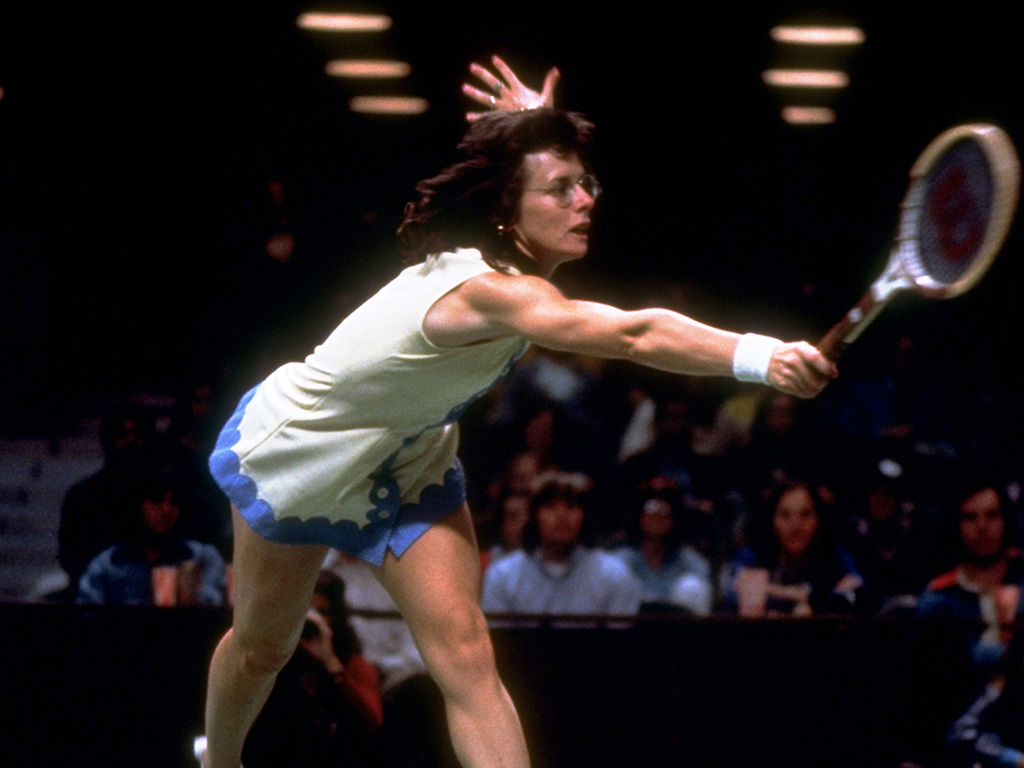
While King and her friends don’t shy away from her flaws and personal struggles, including a previously little-discussed eating disorder, the film mostly centers on King’s relentless drive to win on and off the court. And while ample archival footage displays the still remarkable physicality and dynamism of King’s game (an attacking style critiqued from early in her career as overly masculine), Give Me the Ball! and King’s present-day interviews frequently focus on the wins she sought and won for women more broadly, which, again, is what made her the most famous American women’s tennis player, and perhaps American women’s athlete, of her time. For those of a certain age, particularly those who weren’t attuned to her sport, King’s crossover celebrity made her not just the best-known women’s tennis player throughout the 1970s; she was American tennis, full stop, as publicly recognized, if not more so, than the equally boundary pushing Arthur Ashe and a host of other highly decorated but less socially engaged American stars, including Evert, Martina Navritalova, John McEnroe, and Jimmy Connors.
To this point, King’s cultural relevance throughout her playing career, which stretched from 1959 to 1990, is illustrated in the film by clips from the many interviews she gave to smirking and dismissive male television hosts prodding her views on women’s rights, abortion (pre-Roe v. Wade), and her relationship with Marilyn Barnett that finally, publicly exposed her bisexuality in 1981. What’s particularly unsettling about the interviews following this episode is King’s appearance, several times, alongside Larry (to whom she remained married for several more years), being compelled to apologize for what’s presented as an extramarital affair, without acknowledging (that is, effectively still denying) who she’s finally understood herself to be.
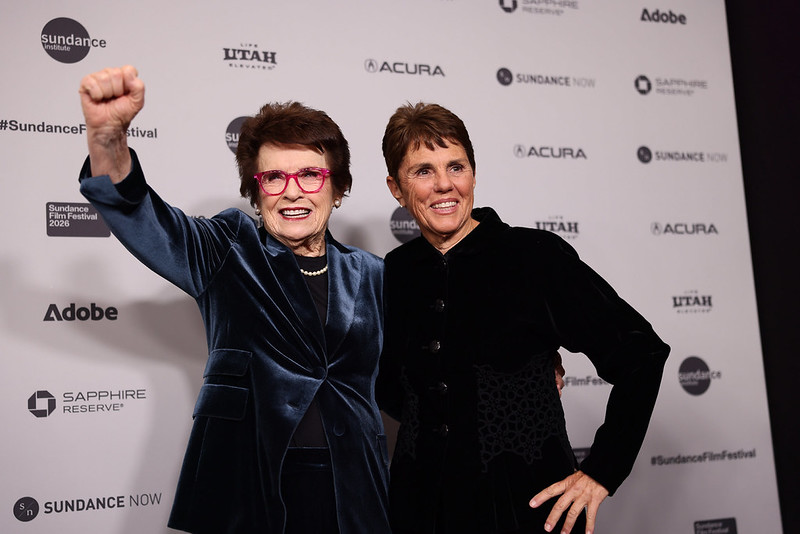
Both staying in the marriage and these compulsory public acts of contrition highlight a less commented upon but truly heroic aspect of King’s personality: her capacity, especially when she’s up against her greatest challenges, to sacrifice herself for ideas and the organizations that embody them. Tennis fans are aware of the mental and physical costs to players who spend most of their careers losing. And as an aggressive showman (showperson?) King certainly brought a lot of additional attention and pressure to win upon herself, as evidenced by one of the most infamous moments of her career, electing to take on Bobby Riggs in the so-called Battle of the Sexes at the Houston Astrodome in 1973. But a viewer of Give Me the Ball! is left convinced (and not just by King herself) that her physical and emotional sacrifices, however personal or grotesquely public they may have been in the moment, were, finally, motivated by her deeply sincere desire for the advancement of others, particularly those who, like her, were denigrated and kept silent, fearful, and in hiding in the openly and unapologetically misogynist, racist, and homophobic pre-Roe America from which we may have imagined that we’d moved on.
The most repeated King aphorism, “Pressure is a privilege,” is left unspoken in Give Me the Ball!, though we see it clearly stamped on a plaque at the players’ entryway onto Arthur Ashe Stadium at the Billie Jean King National Tennis Center, in Flushing Meadows, current home of the US Open. Garbus’ surprisingly eye-opening documentary (you’d be dead wrong to think there’s nothing more to learn about Billie Jean at this point) provides welcome new context for this statement and how it’s guided King’s life. But even more importantly, the film and Billie Jean challenge us with a quote from Coretta Scott King that BJK says is one of her favorites: “Freedom is never really won, you earn it and win it in every generation.” With deeply regressive and violent forces trying to haul us all back to social conditions against which King struggled and, in her own moment, sometimes, at least partially triumphed, Give Me the Ball! is essential viewing, whether or not you watch tennis or give a damn about sports, to inspire the kind of purpose and courage and commitment to community we all need right now.
Read more of our Sundance festival stories and enjoy all of our Arts and Culture coverage. And while you’re here, subscribe to our print magazine and get 6 copies of Salt Lake magazine each year.