
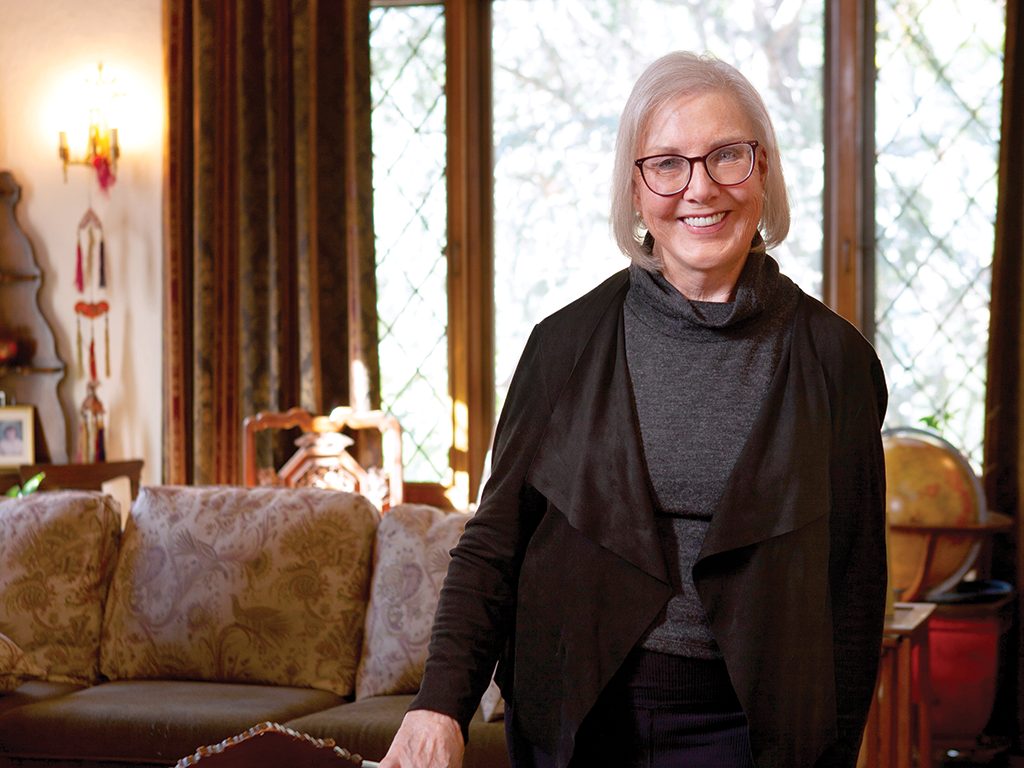
If the steps at the state capitol could talk, they’d know the cadence of Katharine Biele’s footsteps by heart. The 76-year-old president of the Utah League of Women Voters has tread them too many times to count, earning her rightful place as a watchdog for voting rights and transparent governance in Utah. In 2024, Salt Lake Tribune readers named Katharine, “Utahn of the Year.”
“I certainly wasn’t expecting that,” she says with a chuckle. “I didn’t even know I was nominated until they told me I’d won. But I took it as a win for the League.”
It’s one of many recent wins for the organization over the past few years. Founded nationally as the successor to the suffrage movement in 1920 after women gained the right to vote, the nonpartisan, grassroots civic organization spread its branches to every state in the Union, including Utah.
As for Katharine, a journalist by trade, she is more accustomed to asking the questions than answering them—avoiding the spotlight, not reveling in it. Even as League president, she treats democracy like a beat reporter treats city hall—continuously probing, studying and reading the fine print. And while Katharine is more at home writing op-eds, shaping strategy and attending hearings, she has learned to lean into visibility, speaking out publicly—often on those capitol steps—on issues like voting rights, ballot initiatives and redistricting.
“I sort of fell into this role by accident,” says Katharine, who describes initially responding to a plea in LWV’s weekly email newsletter for help with their website. “I knew nothing about websites, so I thought, well, this will be fun.” She joined them, writing communication material and voter guides, but soon found herself taking on dramatically larger roles.
From Reporting to Reform
A Salt Lake native, Katharine’s career began in newsrooms. With a master’s degree from Northwestern’s Medill School of Journalism, she spent years covering stories abroad in Taiwan and Hong Kong, then worked for Alabama’s Birmingham Post Herald.
When her brother was killed by a drunk driver in the early eighties, Katharine decided to move back to Utah to be near her parents. She spent nearly a decade as the business editor for the Ogden Standard-Examiner until the newspaper was forced to restructure and Katharine found herself without a job.
“I was a mother, I’d moved back to Utah, and now I found myself suffering from an identity crisis,” she says. “I tried public relations for a little while but realized it was not who I am.”
She was a journalist—that was clear enough. So she met with City Weekly, Salt Lake’s independent, alternative newsweekly, where she became a regular contributor. After over 30 years, she’s best known for writing the recurring opinion-briefs feature “Hits & Misses,” in which she crafts sharp and insightful commentary on local politics, policy and community issues.
“It was the best choice I’ve ever made. And they’ve been putting up with me since 1992,” she says with a laugh.
At the Helm of the Utah League of Women Voters
Katharine calls her entry into the League a true “baptism by fire.” What began as lending a hand quickly turned into leading the Salt Lake chapter—and within five years, she stepped up to head the entire Utah League. Under Katharine’s guidance, LWV has leaned into watchdog work: producing detailed reports, scrutinizing ballot initiatives and, when necessary, suing the state to uphold the integrity of Utah’s constitution.
In 2022, the League (joined by Mormon Women for Ethical Government) sued after lawmakers repealed Proposition 4, a voter-approved anti-gerrymandering initiative mounted by Better Boundaries, and replaced it with partisan maps. The initiative called for an independent commission to make boundary recommendations, all of which were rejected by the legislature in favor of their own maps.
“None of the maps proffered by the independent commission even created an all-democratic seat,” Katharine points out, adding that the legislature was more interested in a power grab than upholding the will of the people, who’d made their voices known. “It may create a more competitive district, which sounds good to the voter. It’s a reason to come out and vote.”
Katharine says 300,000 eligible Utah women are not registered to vote. “Why is that? Perhaps they think their voice doesn’t matter,” she says. “When we allow gerrymandering to occur, they might be right.”
She says the legislature’s attempt to change or ignore initiatives passed on the ballots is not only a silencing tactic, but it’s illegal. “Proposition 4 is the law of the land, plain and simple.”
“We live in a political environment that can be very negative and depressing.
But getting involved gives me hope, it shows me that change happens.”—Katharine Biele
The Courts Agree
In a string of recent courtroom showdowns, the League of Women Voters has cemented its reputation as Utah’s unlikely guardian of fair representation. After helping secure a 2024 Utah Supreme Court ruling affirming voters’ initiative rights—and successfully challenging the legislature’s misleading “Amendment D”on last year’s ballot—the league notched another victory this past November.
Third District Judge Dianna Gibson tossed out the legislature’s partisan map (twice) before adopting a neutral, algorithm-drawn version that reunites Salt Lake City into a single district for the first time in decades. The legislature, fuming, is appealing and even floating impeachment talk. But for now, the court’s message is clear: Utah’s voters—not its politicians—get the final say.
The Stakes Ahead
Looking forward, Katharine sees both peril and promise. Polarization and mistrust of institutions run deep, yet she remains convinced that citizens, especially when given accurate information and a fair process, are more resilient than they’re often given credit for.
“The reason I joined the League and have stayed for as long as I have is because it’s the one positive thing I can do,” she says, calling herself proof that one needn’t run for office to hold power accountable. “We live in a political environment that can be very negative and depressing. But getting involved gives me hope, it shows me that change happens.”
Read more stories like this and all of our Community coverage. And while you’re here, subscribe and get six issues of Salt Lake magazine, your curated guide to the best of life in Utah.