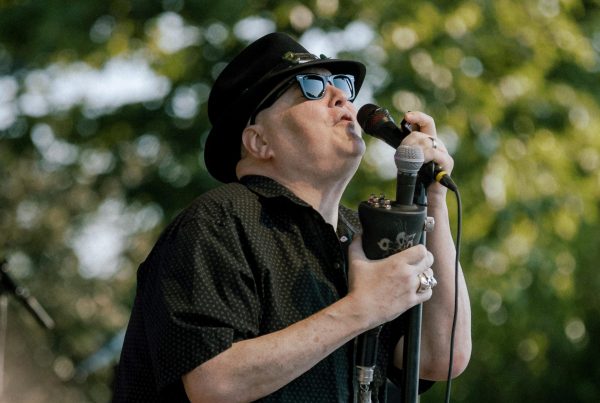
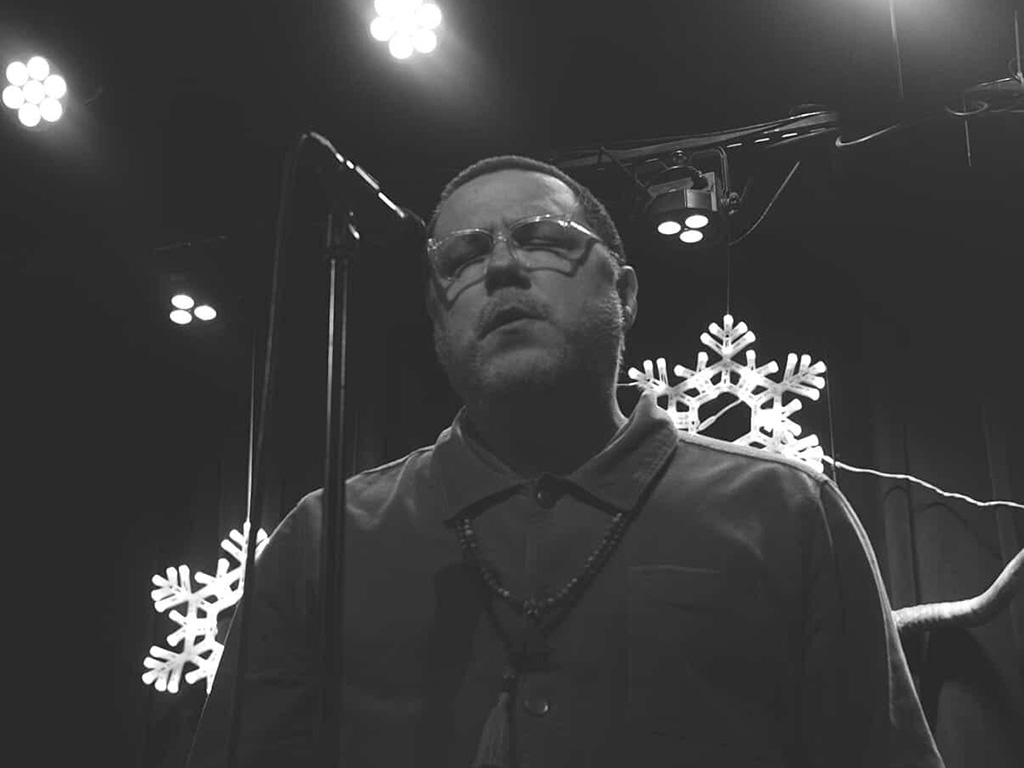
Damien Jurado is a madman, but in that good way. The best way. That passionate stars-in-his-eyes way. When he visits us at Urban Lounge next Wednesday, Feb. 18, he’ll be a few dates into what he’s billing as his greatest hits tour, something he’s never tackled before.
Lucky for me/us, he’s a chatterbox, especially when it comes to music and how (and how often!) he chooses to release it. We had an old-fashioned, face-to-face Zoom conversation recently to mutually nerd out over the quality of recorded sound, the wild ability to immediately release music 10 minutes after taping it, and the lost art of dumpster diving.
Here’s our conversation, in all its glory.
Q: So your 2025 was pretty prolific, to say the least. What, nine releases?
Jurado: Wait ’til you see 2026. My friend, it’s going to be even more.
Q: Did you just wake up one day and decide to start releasing way more music?
Jurado: For ages, between Sub Pop, the first record label I was on, and then Secretly Canadian, those labels were based around me putting out a record every two years. That’s their frame of how they did everything. I’ve always hated the fact that I couldn’t just release music whenever I wanted to. Being as prolific as I was, it was very annoying and frustrating. When I finally decided to no longer work with Secretly Canadian, I thought, well, I can do whatever the hell I want now. I started my own label, and that was it, man; I started releasing music nonstop, from singles to EPs to full-length records. I had the time of my life. I still am.
My fans don’t seem to mind at all. An idea struck me years ago — in 2008, while I was touring Caught In The Trees — when I was selling a brand new album on tour. The question I got the most was, “So when are you going to put out another record?” or “When’s your next one coming out?” Now, in the age of digital downloading, I just thought, man, I’ve got the songs, I’ve got the recordings. They’re done. I’m sitting on mounds of unreleased demos and outtakes, songs that were recorded professionally in a recording studio that didn’t make the album, as well as instrumentals. I thought I should start releasing this stuff. What is the point of holding on to it? And if people are willing to purchase and listen to it, that’s a win-win for me.
Q: I read an interview where you said you almost have a compulsion to release music. Like, you almost need to do it.
Jurado: Definitely. Here’s what I feel: I think there’s something to creating for the sheer love of creating, which I’m all about. But I also believe those creations should be shared, not hoarded. If I left the earth today, I’d want to know that everything I’ve done up to this point is going to be released this year (if it wasn’t already released). I don’t want to leave the Earth with things that have not discovered. That’s a waste. If I’m creating it, I want people to see, listen to, and experience it. Otherwise, what the hell’s the point?
Q: Another side of that is it gives you more control over what you want to get out there and how you want it to be consumed by your fans, so that it’s not released in a way you wouldn’t have done it.
Jurado: Yeah, I’m not a fan of all things being precious. I hate that shit. Hate it. There are countless albums I’ve loved where it took them 30 years to compile this thing before releasing it to the world. You get it, and you’re just like, really? Why did this take 30 years to come out?
I’m not the biggest Neil Young fan, but I will say that guy is doing it right. He’s just like, here’s my fucking archives, have at it. That’s how to do it, I’m a music fan; I’m not just a musician or a businessman. I love and consume music, so I want to own it. I want to be able to listen to it. I think about museums, like the Smithsonian, that are like, “We house Jim Henson’s 10 unseen puppets.” Just show them to us already! Fans want to see that shit, man.
Q: Yeah, what are they waiting for?
Jurado: What are we waiting for? I don’t get it. I was born in the 70s, so I grew up in the era of analog. The fact that I can record something in a studio or on my phone and put it out into the world with no record label, no contract signing, nothing, it absolutely blows my brain out. I cannot comprehend that I can go and record a new song and put it out within 10 minutes, with artwork and everything, and it’s yours. That’s insane to me. So what am I waiting for?
Q: And that thought’s tied to something else I read not long ago, where you said you’re no longer doing physical releases. Is that correct?
Jurado: That’s not true, but I did take a break for environmental reasons. I wanted to experience the wonders of the digital media world, the instantaneous. Like, I own this now. Boom, it’s mine.
There is something to waiting, though. I love the anticipation of waiting for something to arrive in the mail. And I love tangibility. I grew up with tangible everything. I mean, I’m sitting next to a typewriter. It’s super slow. But because of my age and how I grew up and the areas I grew up in, I am constantly amazed and wowed by the technology of today, and I use it as a tool. There are ways of doing it.
I’m not anti-AI—AI is not the boogeyman. Obviously, a lot of people disagree with me, and that’s fine, but I’m telling you, there is something to the wonders of the day and age we are living in. Our finite minds cannot comprehend what’s happening in the world of technological advances in aviation, in medical science, in music. It’s insane. I remember being without this stuff, and it sucked. There’s nothing romantic about it. It fucking sucked. At the same time, I’m a big fan of the slow movement. I love anticipating a package that’s going to arrive. Typing out a letter to a friend. Writing a letter by hand. All of that is beautiful.
[holds up tape recorder] I’ve owned this cassette recorder for ages. I use it all the time, but I’m also a mobile phone user. I’m not anti-technology. But to answer your question: I haven’t stopped creating physical products. I’m back at it again. I just did a preorder for some compact discs coming out relatively soon, so I’m all for it.
Q: Speaking of tapes, you got your start on a cassette-only label, right?
Jurado: Yeah, Casa Recordings. My own label. It was also very environmentally thoughtful and driven, because we used recycled cassettes to put our music out. Instead of ordering new plastic, we used whatever was right in front of our faces. That label started in the house, late at night, in the mid- to late-90s, along with a friend of mine. There was a Muzak company blocks from where I was living, and they threw out boxes and boxes of cassette tapes. We would dumpster dive, get all their cassettes and put my and my friend’s music out on those cassettes.
Q: Essentially just recording over what was on there already.
Jurado: Yeah, just erasing whatever was on there and putting our music on. It’s how all my first recordings were done, all mail order and super limited edition, which is exactly what I’m doing now. I don’t do distribution. I did for a time, and it was a total nightmare. I don’t recommend any record label. Direct to consumers is the way to go.
Q: It seems there’s been a return to cassette tapes and cassette-only album releases. Any opinion on that?
Jurado: It’s cool, you know. Whatever floats your boat. In some ways, it’s almost time that we are honest about how we listen to music. There’s so much romanticism around a cassette, my lord. I mean, I am absolutely obsessed with cassettes. I own a lot of them. The sound quality is insanely beautiful. And the more worn out it gets, the better it sounds.
There’s a high bias that comes with that cassette. I mean, the very first thing you hear, as soon as you push play, is that sound, right before Mötley Crüe or whatever comes on. My first memories of the cassette are hearing that hiss. Vinyl can be the same way. I was never a massive fan of vinyl, though. It felt like, no matter what turntable I put it on, it didn’t sound that great. It sounded thin, especially on hardcore and punk records. I was like, where’s the bass? That’s my biggest complaint, especially on records from the ’90s; they were the worst-produced pieces of shit ever, but still great music. We’re getting better at that now.
I don’t know if I’m just a curmudgeon now, but there should be a little pushback. I love vinyl and it’s great. But I also want to hear that clarity. For me, sorry, digital just wins, man. I get the romanticism. It’s cool. But there’s something about a format that is deteriorating as you’re listening to it, you know? It’s really weird.
Q: I almost feel the same way about some digital music, where you don’t always get those highs and lows. It does depend on how you’re listening, how it was recorded and how it’s going to come across using headphones. You have to consider that, right?
Jurado: It’s funny, though, what we’re talking about. Here’s the reality about fidelity. It’s only music nerds like you and me and our friends and your friends who really give a shit. My son is 13 and he doesn’t care what the format is, what the bias is or whatever. If he’s able to listen to Tyler, the Creator on this mono speaker, he’ll do it.
Q: And he’ll be happy.
Jurado: He’ll be psyched!
Q: There is an extra level to listening, especially for the audiophiles. I’m not sure I’m at that level where I totally obsess about music sounding a certain way.
Jurado: I am one of those people. I’m not just a musician. I’m also a sound nerd. So It better sound good.
Q: So, what you said earlier about this year being even crazier than last year with the amount of releases you have planned, do you have that all mapped out already?
Jurado: I have a whiteboard next to me, and I’m looking at every release I’ve written down; currently, there are seven. That’s a good amount. Not to give too much away, but that will include two full-length albums and a whole load of EPS. I’m a massive fan of the EP. Big fan. I loved him when I was a teenager. I love them now. And I don’t know if it’s my ADHD, but I love singles, too.
I’ve always had a beef with the LP. A lot of full-length albums, front to back, aren’t so solid. I’ll probably be raked over the coals for saying this, but it’s true. There’s something a little masturbatory about the LP as far as I’m concerned. And I put out a 17-track album once. What the fuck was I thinking? It could have been four EPs. It probably would have been better received.
The LP is hard for me, but I’ve done a whole career making LPs. I’ve made a living off of making LPs. A lot of my fans definitely love the LP, too. But I am now in this realm where I want what I’m doing to reflect who I am, and who I am is a big fan of smaller releases.
Q: There’s been a shift in album length, especially with newer bands — maybe they’re the ones driving this — but a lot are 30 minutes with eight songs. They’re getting shorter.
Jurado: Yeah, it’s true. I came to Bob Dylan so late in my life. Now that I’m in it, I’m obsessed. I love Dylan. But I remember seeing the clock time of Nashville Skyline. It was about 27 minutes, maybe 26. I mean, it’s a short record, right?
Q: And it’s so good!
Jurado: So good. It’s the perfect album, but not because of the songs alone. It’s the length, right? It’s so fucking good. There was a band, The Music Machine, and they released a single that was only a minute and 22 seconds long. It’s a great song with maybe six changes within it, which is so insane. But it’s great. Perfect. I can’t pay attention to anything, so I love it.
I love really long movies. I love a super epic, long, four-hour movie. But as far as music goes, it’s wham bam and I’m out, like a drug. I’m high. I got my shit. I’m rolling. And I’m out.
Q: You put out a book recently, right?
Jurado: It’s called Private Hospital. The idea behind that was giving the earth a break. I’m a big fan of found photos; I’ve collected them for ages. Most become album covers. I decided to make a book of these photos, and it comes with a postcard, a found photo postcard, with the download code on the back. It’s how you get the album, because I never did a CD or LP for that one.
Q: Is your tour tied to your latest release? Or was it just time to get out there again?
Jurado: One of the many benefits of what I’m doing now, running my life the way I am with my music, is that there are no rules. I’m not tied to a release schedule. I’m not tied to touring campaigns. I’m so over that. Now I just tour when I want to tour. It felt like it’d been a while since I’ve been to some places. I thought I should get out there again. It’s based solely on people sending me messages, saying, “When are you going to come back to Colorado?”
Q: They miss you.
Jurado: Right. It’s why I’m doing this tour. It’s the only reason.
Q: It’s how it should be, too, because then you’re automatically well received in those places.
Jurado: Yeah, yeah. And this next tour is going to be all the greatest hits, man. I can’t believe I’m saying that, but I’ve been around long enough now to just rock and do a greatest-hits tour. And let’s be fucking honest, that’s all that fans want. You’re paying this much money for a ticket. You’d better be playing “Blowin’ in the Wind.” You better be playing “The Needle and The Damage Done,” right? We want to hear it. We want to see you play it.
I have been horrible to my fans by just playing whatever the fuck I want. I got to give them what they want, finally. So that’s what I’m doing: greatest hits tour.
Q: It does suck when you go to a show and you’re three-quarters into it before you’re like, “Oh! I know this one!”
Jurado: Exactly, exactly.
Q: It’s why some cover bands are almost better received than who they’re covering, because they’re playing nothing but the hits. Every single song.
Jurado: That is exactly right. So what I’m saying is, I’m going on tour as my own cover band.
Read more of our Music coverage and get the latest on the Arts and Culture scenein and around Utah. And while you’re here, subscribeand get six issues of Salt Lake magazine, your curated guide to the best of life in Utah.