
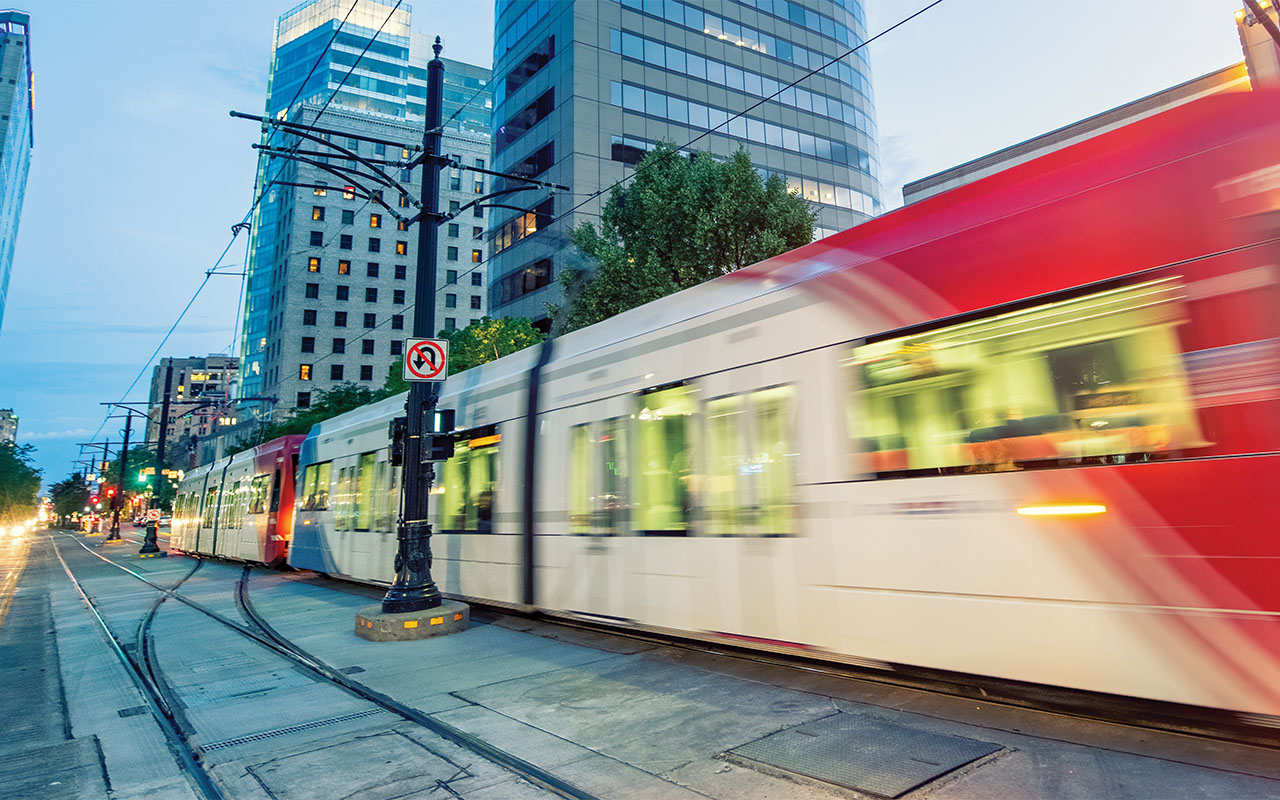
A few times a year, for the last decade since I bought a car, I would remark to a friend that I wanted to start driving less. This year, I resolved to follow through with it. The question then becomes… how? How do we get out of our cars and commute to work and also continue to play and explore Utah’s cities and recreation areas while traveling by rail, bike, foot, or scooter (or unicycle, if you like)? One of the things that I have rediscovered in weening off my reliance on my car is how little I had to give up in the transition, and the things that I have gained outweigh them.
The challenges to committing to alternate modes of transportation also merit acknowledging. Predominant among them is the fact that, largely, our communities were designed for cars and not for bikes, scooters or pedestrians. Benjamin Wood is a board member of Sweet Streets, a non-profit that advocates for people-first design. “For decades now, we’ve been building cities for cars and not for people,” he says. But things are changing. Wood believes we have hit the high-water mark for our community’s over reliance on cars—making this the perfect time to start the transition away from driving.
Safety First
The decades of car-focused community design have had dire consequences for the safety of everyone else trying to get around. Are our streets safe for cyclists and pedestrians? The short answer: “No. Our streets are horrific,” says Wood. “We track every pedestrian death, every street death, and there are about two deaths per month on our surface streets in Salt Lake City.” Road incidents killed 40 pedestrians and nine cyclists in Utah in 2023, according to data from the Utah Department of Transportation (UDOT) and the Department of Public Safety (DPS), and even that is a dramatic drop from 2022, which had 53 pedestrian deaths and 15 cyclist deaths.
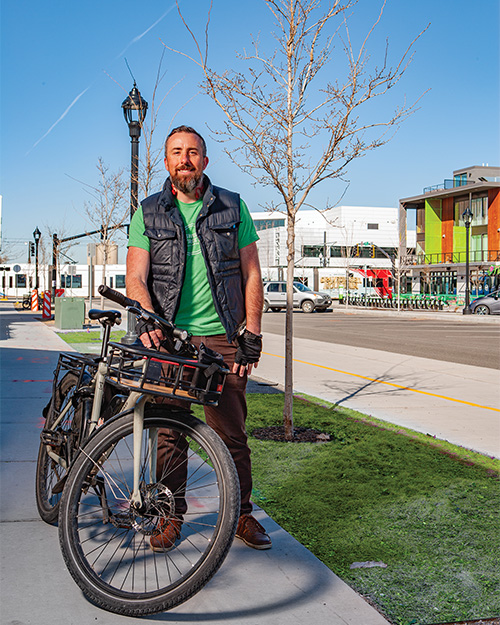
“We’ve designed our streets in a way that encourages drivers to hit the gas,” says Wood. “I don’t necessarily blame drivers for this either, because they are responding to the built environment. We’ve built highways through the hearts of our cities, and we’re losing people as a result.”
- Roads to avoid: Studies have identified that the most dangerous roads for pedestrians are busy, multilane roadways (four or more) with speed limits at or above 30 mph that are adjacent to commercial retail, have billboards or border low-income neighborhoods. In Salt Lake City, think State Street or 700 East, even if they have sidewalks and bike lanes. “Those big major arterials are controlled by UDOT, and they’re actively hostile to anyone who’s not inside of a car,” says Wood. Instead, there are safer options for people who are not driving. Neighborhood byways discourage cut-through vehicle traffic, providing street crossings and connecting people to popular destinations. The city has identified streets that are naturally slow speed and is turning some of them into neighborhood byways (such as Kensington Avenue, Westpointe and Jordan Meadows, Poplar Grove, Rose Park and Fairpark, 800 East and 600 East).
- Urban trails are paved pathways that cut through cities, typically cordoned off from car traffic, for pedestrian and bicycles, that can also provide a safer commute.
- Protected bike lanes provide a safer alternative to typical bike lanes, such as the painted bike lane protected by a parking lane from the travel lanes on much of Main Street in Salt Lake City. (There are also protected bike lanes on 300 South, 300 East and 200 East.)
The city is also participating in initiatives like the Vision Zero Network and the Livable Street Program to increase pedestrian safety. “Block by block, the city is identifying trouble areas and making fixes,” says Wood. During the 2024 session, the Utah State Legislature passed H.B. 449, which requires UDOT to consider cyclist and pedestrian safety during the planning process. It also allows road funding to be spent on pedestrian and cyclist infrastructure and safety measures.
“It took us decades to build what we have right now,” says Wood. “It will take equivalent decades to build a new version of our streets, but we have started that process.”
How and when to drive less
To get you started on your journey, these are some basic steps and things to keep in mind:
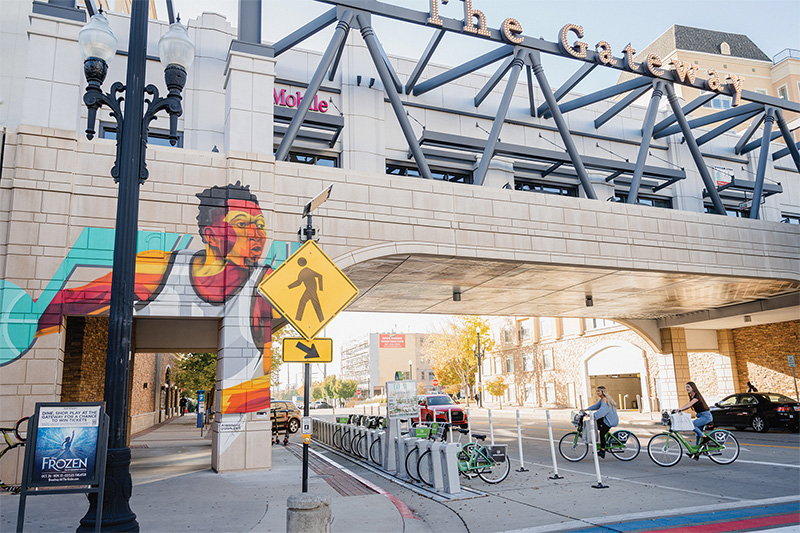
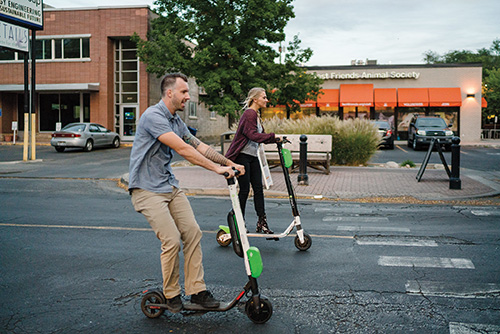
- Get a bike. If you have a bike and you’re able to use it, that’s step one. If you don’t own one, consider a GreenBike membership or scooters that can be rented through mobile apps like Spin and Lime. BikeLink has bike storage lockers at most intermodal transportation hubs from Ogden to Provo. For those who have disabilities, the Utah Transit Authority offers Paratransit and other accessibility services.
- Combine modalities. The train or bike alone is not a substitute for the car, but when you combine them or add your feet, scooter, etc., that’s what replaces a car.
- Look for high-frequency bus routes. High-frequency route buses typically arrive every 15 minutes on weekdays and every 30 minutes on weekends. “That was the beginning of my transformation,” says Wood. “I moved to an area that was serviced by a high-frequency bus route, and that was the game changer for me.” If the bus comes every 15 minutes, people don’t even have to think about scheduling. They include Routes 1 (South Temple–1000 North), 2 (200 South), 9 (900 South), 21 (2100 South), 200 (State Street) and 217 (Redwood Road)
- Know your comfort level. If the bus feels intimidating, start with just adding the train—as you can see where it’s going and how often it’s going to arrive. Start with train rides, where feasible, and go from there.
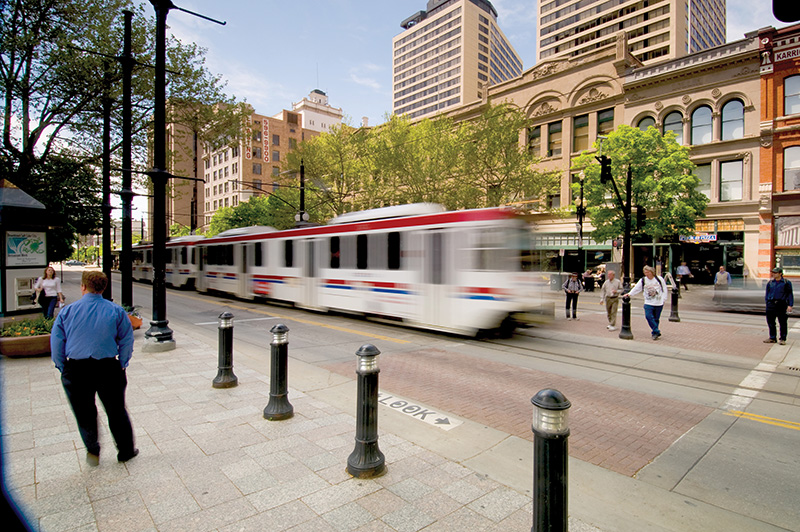
- Try it for a day. Not ready to commit to ditching the car every day? Try it out for a special event. Most of our big event venues have a train stop next to them. A concert at Gallivan Center? There’s a train right there. Shopping at City Creek? There’s a train right there. Football game at the University of Utah? There’s a train up there. Instead of leaving the show early to escape the parking lot before the crowds, skip the parking hassle entirely and take the train. Bonus: downtown SLC is a free fare zone
- Make it an adventure! You can get to some of the Wasatch Front’s popular recreation areas or nearby hiking trails without a car. “I’m a mountain biker,” says Wood. “I use the train to get to the trails, and then I’m freed, right? There’s no need to park or find a place for my car. I hop off the train and I’m on the mountain.” Some of his favorite trails:
1. Take the Red Line up to the University of Utah, there you can catch the Bonneville Shoreline Trail.
2. Take the Blue Line to Draper and hit trails Corner Canyon.
3. “There are also several different train stops that hit the Jordan River Trail. So about once a month, I ride the train to Draper and I bike home [to Poplar Grove].” It might sound intense, but “the best thing about where we live here in Salt Lake City is it’s downhill. Everything drains into the Great Salt Lake. So, from just about anywhere, you have a majority downhill ride back to your house.”
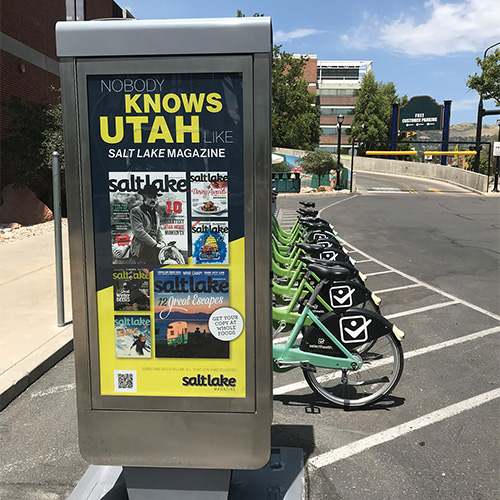
No Wheels? No Problem. Greenbike Has You Covered
A non-profit bike share company, GreenBike allows riders to check out bikes from stations conveniently and strategically located around Salt Lake City and now has electric-assisted bikes to help you tackle Salt Lake’s hills. GreenBike, along with other rental services, can help make those last-mile connection.
Why drive less?
That is the “how.” Now, let’s clarify the “why.” Why drive less? “Every time you turn the engine on your car, whether it’s a hybrid, an EV or a gas-powered car, you are polluting the environment and contributing to climate collapse,” says Wood. “I’m not saying it’s easy, but one of the most effective ways to reduce your carbon footprint is to drive less.”
There is also Utah’s air quality to consider. During an inversion, dangerous particulate matter, such as PM 2.5, accumulates in the air. One of the primary contributors to PM 2.5 on an inversion day (up to 48% according to the Department of Environmental Quality) are emissions from vehicles, trains and aircraft. On-road mobile sources also produce about 39% of the total annual man-made pollution (NOx, PM2.5, VOC) along the Wasatch Front.
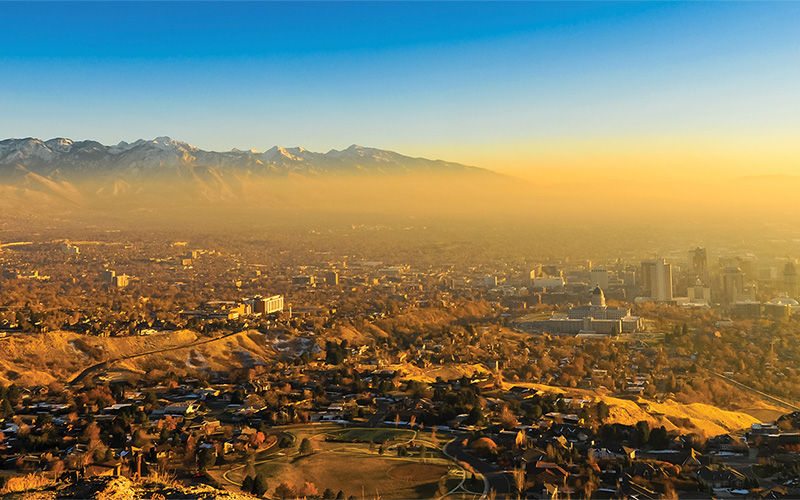
In addition to doing our part to help our environment, there are a couple of other perks: never sitting in rush hour traffic jams or having to find parking. There are other quality-of-life improvements to ditching our cars.
“It’s hard to even describe how great it’s been. The less I drive, the less I miss driving,” explains Wood. A journey by car tends to be destination-focused—you get where you’re going on the fastest roads possible. When you’re driving, there is not as much of an opportunity to engage with your city on the street level. “Now that I’m biking and using transit and walking, I’m noticing the changes year to year, season to season. I’m finding the coffee shops that are closer to me, the parks that are closer to me, the bakeries that are closer to me,” says Wood.
“People often think about what they lose if they stop driving. And what you’ll find, when you make the switch, is you gain much more than you lose in just terms of community, connection and a sense of place and home in the city you live in.”
Ways to Pay UTA Fares
- Hive Pass: The Hive Pass is a discounted UTA transit pass available to all Salt Lake City residents. You can use the Hive Pass on UTA local bus service, TRAX, the S-Line streetcar, UTA On Demand and FrontRunner. The Hive Pass also includes a one-year GreenBike membership. The pass costs $42 monthly (75% off a regular monthly UTA pass). There’s also an option to pay for the whole year up front for a bigger discount. Purchase at slc.gov/hivepass.
- Mobile App: Use the Transit mobile app to purchase almost all UTA fare types, including a reduced fare option for qualified riders. Transit also offers the ability to choose third-party options like bikes, scooters and rideshare services. transitapp.com
- Prepaid Card: A prepaid, reloadable FAREPAY Card saves cardholders 20% off local bus, TRAX, S-Line, and Express Bus fare and up to 20% off FrontRunner fare (after an initial $20 purchase of the card). Purchase and reload a FAREPAY card online. A reduced fare FAREPAY card is also available to all qualifying seniors, youth, people with disabilities and low-income individuals. The 50% discount includes Bus, TRAX, FrontRunner, S-Line streetcar, UTA On Demand and Ski Service. farepay.rideuta.com
Skip Parking at Popular Events
In Northern Utah, most major venues and stadiums are conveniently located near light rail stops. The UTA “Ticket As Fare” program allows event ticket holders to ride UTA services to various pre-approved events for free.
- Abravanel Hall: TRAX Blue Line or TRAX Green Line to Temple Square Station
- America First Field: TRAX Blue Line to Sandy Expo Station
- Capitol Theater: TRAX Blue or Green Line to Gallivan Plaza Station
- Delta Center: TRAX Blue Line or TRAX Green Line to Arena Station
- The Depot: TRAX Green Line to North Temple Station, walk to Depot
- Eccles Theater: TRAX Blue or Green Line to City Center
- LaVell Edwards Stadium: FrontRunner to Provo or Orem Station, transfer to UVX to BYU Stadium Station
- Davis Conference Center: FrontRunner to Layton Station, transfer to Route 628 to Center stop
- Lindquist Field: FrontRunner to Ogden Station, transfer to Route 601 to the stadium
- Maverik Center: TRAX Green Line to Decker Lake Station
- Mountain America Expo Center: TRAX Blue Line to Draper Station
- Ogden Amphitheater: FrontRunner to Ogden Station, transfer to Route 601 to Amphitheater stop
- Smith’s Ballpark: TRAX Blue, Green or Red Line to Ballpark Station
- Rice-Eccles Stadium: TRAX Red Line to Stadium Station
- Utah State Fairgrounds: FrontRunner to Salt Lake Central Station, transfer to Green Line to Fairpark Station
- UFCU Amphitheater: TRAX Red Line to Murray Central Station, transfer to Route 54 to Copper City Drive
Salt Lake City Street Car
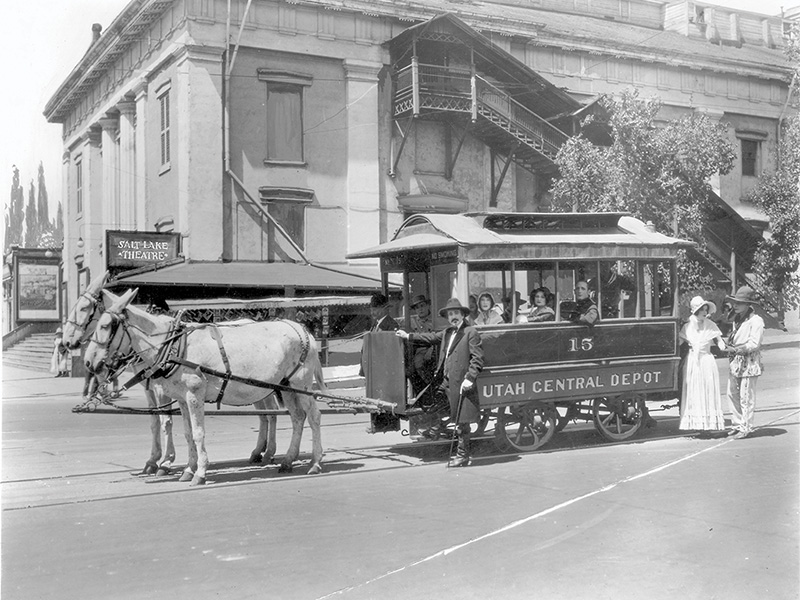
Salt Lake City’s main arteries may be dangerous for pedestrians now, but it wasn’t always that way. Recently, workers were redoing some parts of State Street, when they exposed an old rail. “People were so shocked to see this rail in the middle of State Street,” says Wood. Once upon a time, Salt Lake City was designed with the trolley car in mind. “Virtually every neighborhood in Salt Lake City 100 years ago had an electric high-frequency trolley system running through it. That’s how most of our neighborhoods were built—as streetcar suburbs.” It’s why Salt Lake has these massively wide streets; they used to have a trolley going down the middle of them. “And we tore that out,” says Wood. And if we tore it out, we can put it back in.