
Rainbow demonstrations, civil rights clashes, rallies, walk-outs and viral TikTok accounts—marginalized students at BYU may be more visible than ever before, but can increased visibility lead to increased understanding and acceptance within the wider community? Current BYU students share their perspectives.
On the evening of March 4, 2021, Maddison Tenney was working late deep within a ceramics studio on the Brigham Young University campus when her phone started buzzing with activity. “My phone starts blowing up,” she says. One message asked, “Are you watching?” Tenney walked outside. On the mountain above the Provo campus, the iconic “Y” lit up the night in rainbow colors.
For Tenney, who first started to realize she was queer in 2017, it was a revelation. “The idea that someone who didn’t even know me, who loves me in such a powerful way that they’re willing to climb a mountain, really gave me the confidence and sense of belonging that I needed,” she says.
The group Color the Campus lit up the “Y” to “show love and support for LGBTQ+ students and faculty at all CES [Church Education System] schools.” The cascade of events that led up to the rainbow-lighted “Y,” and the events that followed, demonstrate the sea of uncertainty for those navigating existence in the margins of the community.
Community from visibility
One year before, in February of 2020, BYU made a change to its Honor Code, excising an entire section from the CES handbook about “homosexual behavior.” Every student and staff member at a CES institution, such as BYU, signs the Honor Code, agreeing to obey its strictures or face discipline. The removed section of the 2020 code reads, in part: “Homosexual behavior is inappropriate and violates the Honor Code. Homosexual behavior includes not only sexual relations between members of the same sex but all forms of physical intimacy that give expression to homosexual feelings.”
In the wake of the change, stories started circulating of queer BYU students celebrating by coming out publicly or demonstrating physical affection—holding hands, hugging, kissing—openly for the first time. For some, the change represented a shift toward greater LGBTQ+ acceptance, even if only tacitly. The celebration was short-lived. BYU tweeted shortly after the change to the handbook, “We’ve learned that there may have been some miscommunication as to what the [2020] Honor Code changes mean. Even though we have removed the more prescriptive language, the principles of the Honor Code remain the same.” BYU representatives went on to say because dating means different things to different people, the Honor Code Office would handle any questions on a case-by-case basis. Still, some hoped, could there perhaps be room for LGBTQ+ students to date openly like their heterosexual peers?
The answer was no. Two weeks later, CES leadership followed up with a letter, stating, “One change to the Honor Code language that has raised questions was the removal of a section on ‘Homosexual Behavior.’…Same-sex romantic behavior cannot lead to eternal marriage and is therefore not compatible with the principles included in the Honor Code.”

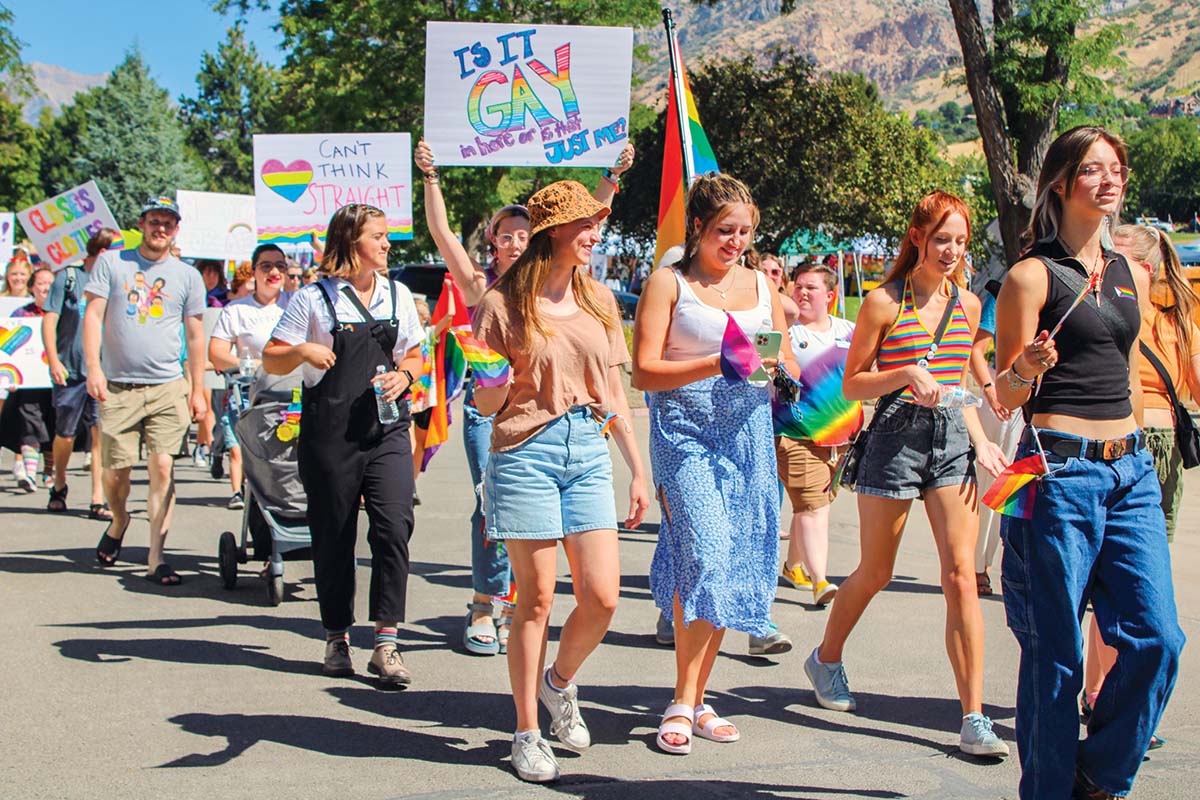
Then, the demonstrations began. For days, students clad in rainbows and holding signs gathered outside of the Wilkinson Student Center on BYU campus to protest what some saw as a reversal of the Honor Code change. Some students say they felt betrayed, lured into coming out or being open with their relationships, only to have that openness taken away. The swift arrival of the COVID-19 pandemic and shutdowns threatened to undermine the movement’s momentum, but the cat (or cougar) was out of the bag.
BYU student and representative of Cougar Pride Center, Mariane Rizzuto, recalls how the campus landscape changed from before to after those short weeks in Winter 2020. “In my experience, everything my freshman year was really hush-hush. I didn’t know any people who were out publicly. I think a lot of [non-LGBTQ] people were less cautious about their words and might say something inadvertently homophobic,” she says. “There are definitely people who have been, and continue to be, very hostile towards our community.” But, she believes the issue is that, overwhelmingly, many people on campus never had to think about queer issues until recently.
A year to the day after the CES letter sparked protests, students were back on campus and looking up at a rainbow “Y” for the first time. BYU, once again, reacted with a tweet, saying, “BYU did not authorize the lighting of the ‘Y’ tonight.” Authorized or not, Maddison Tenney was inspired.
“I went home that night and started the ‘Raynbow’ Collective,” she says. It began as a small Instagram account with the goal of sharing the stories of queer BYU students and their experiences—“The good, the bad and the ugly,” says Tenney. “To give a more holistic view of what it’s like to be queer at BYU.” As time went on, “We started getting really big really quick,” she says.
“It’s become clear how big the community is,” says Rizzuto. “I think there was some real power in seeing a bunch of queer students gathering and resisting, on campus, very visibly.” And visibility begets more visibility.
Raynbow Collective joined existing student groups like Understanding Sexuality, Gender and Allyship (USGA) and the Cougar Pride Center (CPC), further amplifying the visibility of BYU’s queer community as a whole. “It’s all about proximity, right?” says Tenney. “Queer folks aren’t some kind of scary monster. We’re your neighbors, family members and friends. We’re in your Relief Societies and wards. I think the increased visibility and proximity has really created a lot more openness and increased the need to address the student population as it is.”
It’s also provided the community that students like Rizzuto had been looking for. Early in her education at BYU, the other queer students close to Rizzuto transferred to UVU. “I felt like I was suddenly alone at BYU again,” she says, then she came across an application to join CPC. After joining, she says, “I definitely think I have a community now that I never really felt like I had my entire life.” And, the newfound openness has helped other queer students find the same. “People now have access to information on where to find community in new ways.”
The push-pull of progress
(Check out our Interactive Timeline on the History of Student Activism at BYU)
The growing prominence and activity of the queer community and other marginalized groups at BYU has not come about without resistance. After the lighting of the “Y,” BYU introduced a policy on demonstrations that explicitly bans all demonstrations on the “Y” mountain, citing safety concerns, and erected a fence around the “Y.” In response, Color the Campus lit the “Y” in trans-flag colors. Then, in June 2022, queer student groups held the first BYU-approved LGBTQ+ demonstration on campus since the introduction of the policy.
In 2019, before the wider protests, BYU political science valedictorian Matt Easton spoke openly about being gay in his commencement speech. The video of his speech has 250,000 views on Youtube. BYU’s Social Science Department approved the speech beforehand, but Easton still drew the ire of LDS Church leadership. In a 2021 speech at BYU, apostle Jeffrey R. Holland posited, “If a student commandeers a graduation podium…in order to announce his personal sexual orientation, what might another speaker feel free to announce the next year until eventually, anything goes?” Holland goes on to quote former BYU president Dallin H. Oaks to implore members of BYU’s faculty and staff to show a little more “musket fire” when defending the LDS faith’s current views on sexuality and marriage.
Easton penned a response letter to Holland in The Salt Lake Tribune, writing, “Within an hour of your remarks, three current BYU students expressed to me how unsafe and scared they felt knowing that church leaders instructed the university’s faculty to use metaphorical ‘musket fire’ to defend the ‘doctrine of the family’ and push back against LGBTQ+ inclusion.”

“I think the coalition building has been incredible. It’s been incredible to see what has been accomplished at BYU. There is so much support from faculty, staff and other students,” says Tenney. “On the other hand, facing active threats of violence has been really difficult, but, ultimately, I think the culture has been moving in a more positive way. And I think that will continue.”
Going into BYU’s Fall 2022 term, Tenney and Raynbow Collective prepared pamphlets for the new freshman gift bags which outlined resources for LGBTQ+ students and allies. The campus newspaper, The Daily Universe initially approved the pamphlets, and Raynbow Collective paid and signed a contract with the paper to distribute the pamphlets. BYU administration decided to remove the pamphlets from the bags after Student Life had started to deliver them to freshman dorms. “That experience was disappointing and disheartening,” says Tenney. “But, it also gave us the opportunity to have a lot of really fantastic conversations about how BYU interacts with outside businesses and organizations.” Reportedly, BYU removed the pamphlets to avoid appearing as if it was affiliated with any of the off-campus groups mentioned in the pamphlets, and the university prefers students to use its new Office of Belonging rather than off-campus resources.
“What we really wanted was for more students to have access to life-saving resources,” says Tenney. BYU’s removal of the pamphlets made headlines internationally. That spreads the word perhaps more effectively than the pamphlets themselves could have. “Even though what happened wasn’t our intention,” says Tenney, “People worldwide were able to help provide queer students with resources, and that couldn’t have happened any other way.”
“Queer folks aren’t some kind of scary monster. We’re your neighbors, family members and friends.”
—Maddison Tenney
Building Belonging
With the growing visibility of marginalized students at BYU, their message to the university is often how the institution could build a place where all students feel like they belong. The fallout from a 2022 talk by BYU religion professor Brad Wilcox put a spotlight on how BYU deals with racism. “‘How come the Blacks [in the LDS Church] didn’t get the priesthood until 1978?’” posits Wilcox in a video of his talk. “Maybe what we should be asking is, ‘Why did the whites and other races have to wait until 1829?’ When you look at it like that…we can just be grateful!” Wilcox later tweeted an apology, “To those I offended, especially my dear Black friends, I offer my sincere apologies, and ask for your forgiveness.”
In response, members of BYU’s Black Student Union (BSU) met with Wilcox. Ron Weaver III, BSU’s VP of Activities, who was in the meeting, says, “I had to correct him.” Telling Wilcox, “You apologized for embarrassing your family and friends. That’s not directly addressing the situation.” They recommended, rather than a statement, Wilcox put out a video explaining his mistake to be seen by all Black members and students. “We said, ‘this would help a lot of people.’ It wouldn’t fix all of the issues, but that would help,” says Weaver, but the video never materialized “That’s my biggest frustration,” says Weaver. “When there’s an issue, everyone would rather be hush-hush. But when we make a mistake, we have to be held fully accountable, as Christ teaches us.” Weaver says he wants the rules to apply to everyone. “Students are held accountable, but people with titles make the same mistakes and nothing is done… If we have grace and mercy for professors, have it for students, too.”
BYU released their report on “Race, Equity and Belonging” in February 2021. In speaking with BIPOC (Black, indigenous and people of color) students, the report found they experienced “loneliness and isolation” because of racism at BYU. Among the report’s recommendations was to create a new office to plan and implement “initiatives to assist students and employees with issues related to race, equity and belonging.” BYU’s Office of Belonging opened its doors in September 2022. Now Weaver says he is working with students in the office to improve representation and address racial inequality within BYU’s dress and grooming standards. This comes after he was brought into the Honor Code Office for a possible violation.
In early 2018, Weaver dyed his hair blond. The Honor Code counselor told Weaver his hair was “unnatural and unprofessional.” Weaver says he tried to crack jokes because being called into the Honor Code Office is a scary thing. “When you get called to the Honor Code Office, it could mean you’re getting kicked out of school for breaking the rules.” But while blond might be a natural, and therefore acceptable, color for a white student, the feeling at the time was that it was not acceptable for a Black student. “Who are they to determine what professionalism is?” asks Weaver. “There are multiple hairstyles within our [Black American] culture that are professional, but they don’t know what they are because they don’t have the right representation.”
The new Office of Belonging offers resources, like a way to report discrimination, and plans to implement “extensive diversity and inclusion training programs” this academic year. Before that, “they had paused all [diversity] training after Elder Holland’s talk,” says Tenney. That was August 2021. During that time, Raynbow Collective provided Equality Educator training with Equality Utah and continues providing DEI training as of March 2023. “We believe that professors and students deserve information about race and gender equality and on how to treat people with kindness and empathy.”
BYU is on the precipice of a new era. This March, BYU announced a new university president to replace Kevin J. Worthen. C. Shane Reese, who has been academic vice president at BYU since 2019, was on the Committee on Race, Equity & Belonging, but reactions to his presidential appointment have been mixed. When BYU cancelled gender-affirming therapy for transgender clients of its Speech and Language Clinic, Reese defended BYU’s decision in a letter to the program’s accrediting body. In response to Reese’s appointment, Raynbow Collective released a statement, “All students deserve a campus that is safe, kind and full of resources. This includes students on the margins, students seeking belonging, and students unsure of where to start.”
“All students deserve a campus that is safe, kind, and full of resources.“
—Maddison Tenney, Raynbow Collective
A kinder place

On just about any social media post about being a BIPOC or queer student at BYU, you are also likely to find a commenter encouraging said students to “get out of there” or “go to school somewhere else.” While the commenters are often well-meaning, Rizzuto says those comments are also not very helpful. “It drives me crazy…We exist in every space, and telling us to just ‘go away’ is unproductive.”
Rizzuto says it also doesn’t account for the many reasons why a marginalized student might end up at BYU in the first place or why they feel the need to stay. “Many of us felt either pressure from our family or some combination of that and financial reasons,” she explains. BYU is a comparatively cheap university to attend and even if a student wanted to transfer, not many can afford to restart their education elsewhere.
“I have some complicated reasons why I chose to go to BYU,” says Rizzuto, whose entire family has attended BYU and whose grandfather was a BYU professor. “But one of them is definitely that I wanted my parents to be proud of me.” In the end, she says, asking people ‘why would you stay there?’ is “saying to the marginalized group that it’s all in us. It’s putting all the pressure on us instead of asking the institution to have some more respect.”
Weaver enrolled at BYU expecting to find a diverse, open-minded community of faith like the one he had back in Chicago. What he found was a lot of ignorance of people of other races and circumstances, like single-parent households. “There were a lot of people who did not look like me, who did not understand where I was coming from.” When he saw racism on campus—with hairstyles or racial slurs—he says, “I was blindsided. I thought, ‘we’re all supposed to be people of Christ.’”
Rizzuto recognizes that some of the concerns involve more than just BYU’s students or campus. “We’re dealing not only with BYU, but it’s reflective of the church, which reflects the culture that most of us grew up in, and our families, and it’s just—it’s a lot bigger than us. And it’s a lot bigger than BYU in a lot of cases.”
Given the chance, Weaver says he would still choose BYU, if he had all of the knowledge he has now. “The reason why I fight for these things is because I would love for my kids to come to BYU. I love this place. This is the place where I met my wife.” But he doesn’t want his kids, or anyone else, to go through what he’s gone through at BYU, so he’s staying to change things from the inside. “Nothing against people who have left. I want to work with them because the overall point is how do we stop people from getting treated this way?”
Faith is a reason why marginalized students first choose BYU and why they choose to stay at BYU…and a reason they want to make it better.
“If we really deeply believed in the inherent divinity then this would be a much kinder place,” says Tenney. “I believe BYU has that capacity. I think the church has that capacity. I know its members definitely have that capacity.”

BYU Student Snapshot
34,390 total students:
Caucasian: 81%
Hispanic or Latino: 9%
Two or more races: 4.5%
Asian: 3%
Pacific Islander: 1%
Black: 1%
American Indian: <1%
According to a March 2022 BYU ‘Campus Climate’ student survey:
Gender: 45% male, 54% female, 0.7% transgender or other
Sexual orientation: 92% straight, 5% bisexual, 2% gay/lesbian, 1% other
In a study released in 2021, of the 7,625 BYU students surveyed, 996 students (13%) indicated a sexual orientation other than “strictly heterosexual.”
More Visibility: Queer Coalition
Cougar Pride Center: a group aiming to empower queer BYU students, celebrate progress and advocate for change through collaborative activism. Among their efforts is the Safe Housing Project which helps connect queer students with affirming housing options. cougarpridecenter.org
The Out Foundation: a group with a mission to empower LGBTQ+ students and alumni of BYU with initiatives based on the needs of students and alumni. The group also provides some guidance transferring from BYU for queer students who reach the “tipping point where they decide to leave.” theout.foundation
Raynbow Collective: a volunteer organization focused on creating and identifying safe spaces for LGBTQ+ students, faculty, and staff at BYU by developing networks with organizations, businesses, artists, and activists to support BYU students. raynbowcollective.org
USGA (Understanding Sexuality, Gender, and Allyship): an “unofficial” group of BYU students, faculty and guests who wish to enhance the BYU community by providing a safe space for open, respectful conversation on intersectional LGBTQ+ topics. The longest-running active group of its kind at BYU. usgabyu.com
More Visibility: ‘Be A Menace’
In February of 2022, a TikTok account called Black Menaces posted its first video in which Black students at BYU react to a fireside chat given by BYU religion professor Brad Wilcox. The Black Menace response video has been viewed nearly 430,000 times as of this writing, and The Black Menaces continued to make videos. They pivoted to asking questions of BYU students and posting the various answers in videos on TikTok without commentary from its members. “Who said, ‘Negroes are not equal with other races,’ Adolf Hitler or a church leader?” asks one video. (Answer: It was LDS apostle Bruce R. McConkie.)
The Black Menaces have also started a podcast, expanded into a social media coalition with chapters at universities all across the country and recently led a student walk-out at BYU as part of the nationwide “Strike Out Queerphobia” event to end federal Title IX exemptions for religious institutions. theblackmenaces.org