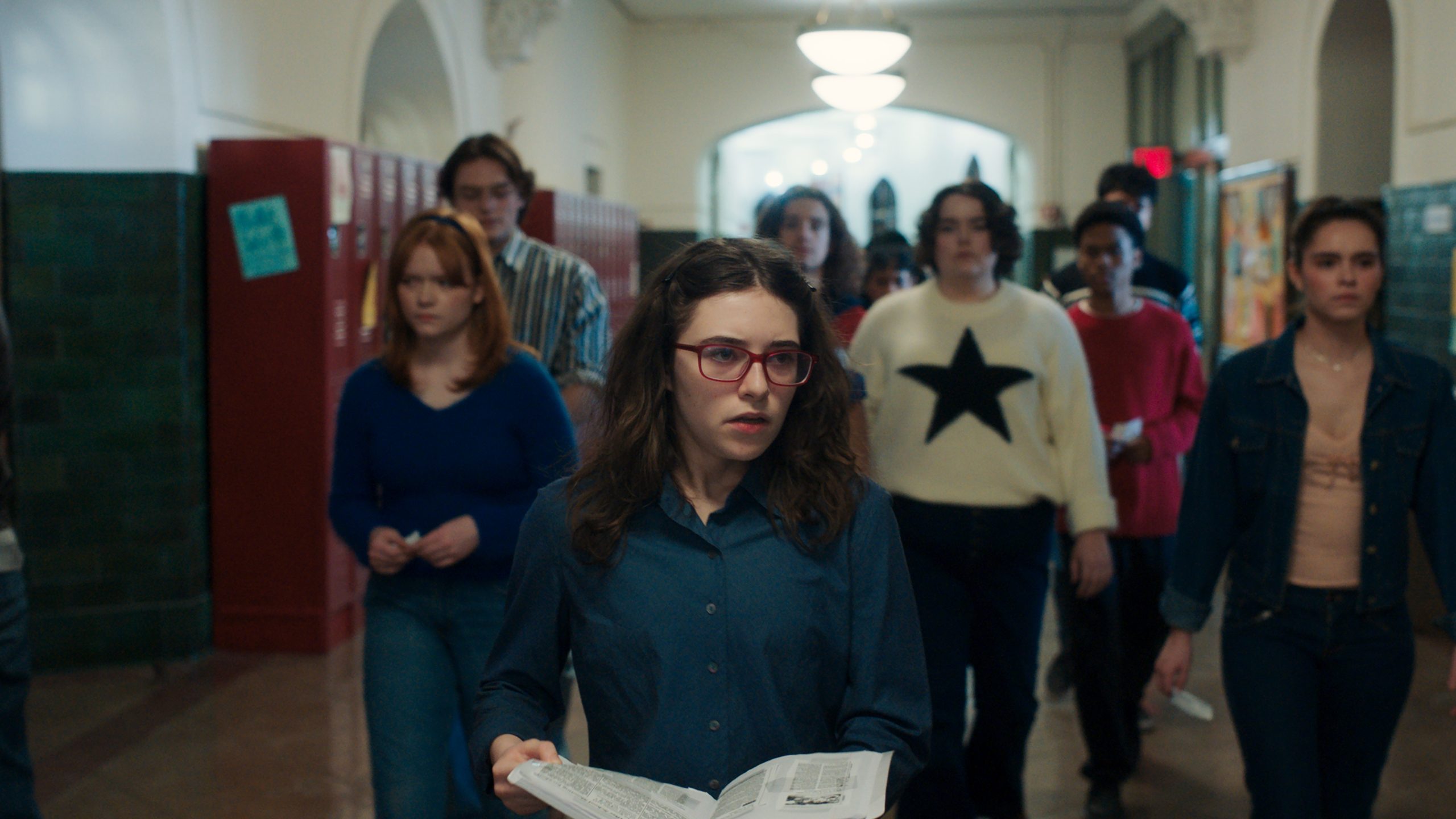
Written and directed by NB Mager, Run Amok premiered at the Sundance Film Festival on Jan. 26, 2026. The film centers on a 14‑year‑old girl who stages a musical to honor the victims of a school shooting—an event that claimed her own mother’s life.
The story opens with Meg (Alyssa Marvin), a determined high school freshman, hauling her harp down the street. The image is both humorous and instantly relatable to anyone who once insisted on lugging an unwieldy band instrument to school. It’s also our first glimpse of Meg’s stubborn resolve, a trait that threads through the entire film.
In history class, a documentary on Abraham Lincoln is derailed by disruptive students. When Meg asks whether the well‑behaved kids can keep watching, the teacher instead sends her to the library to finish the film alone. There, a conversation with the librarian introduces her to the concept of catharsis—the release of difficult emotions. Moments later, she runs into Elton (Jim Caplan), a classmate working on a sculpture for “the commemoration.” Shocked to learn of the event, Meg consults her music teacher, Mr. Shelby (Patrick Wilson), and decides she will create a performance for it.
Though several adults try to dissuade her, Meg insists the show is necessary. These exchanges reveal how deeply she is still mourning her mother and it becomes clear that she’s latched onto the idea of catharsis because she feels she needs it.
As the film unfolds, we learn that a shooting occurred at Meg’s high school ten years earlier, and her mother was among the victims. In response, the school has adopted a controversial policy: arming teachers with bright orange guns that fire rubber bullets. The film uses this detail to echo real‑world debates in the United States over whether arming educators could prevent future tragedies.
Examining the Dangers of Having Guns (of Any Kind) in Schools
Run Amok later underscores the dangers of such policies. When a teacher mistakes Elton’s water gun—intended for his sculpture—for a real threat, he shoots him, injuring his hand. The moment starkly illustrates the risks of placing weapons, even non‑lethal ones, in the hands of school staff.
As Meg and her peers continue working on their project, they grapple with the question at the heart of every school shooting: why would someone do this? Meg eventually confronts the shooter’s mother, portrayed as a woman hollowed by grief and guilt. Like the other adults in the film, she also cannot offer answers, ultimately saying that “it all just went wrong in his head.”
Through startled reactions to loud noises, tense conversations that become shouting matches, and the students’ earnest search for an explanation, Run Amok becomes a thoughtful, affecting exploration of how communities absorb the trauma of school shootings—and how everyone is trying to make sense of why they still happen.
Run Amok premiered and screened at the 2026 Sundance Film Festival. There have been no reports of a widespread release.
More on Run Amok: Run Amok Producer Julie Christeas on Sustainability and Starting Conversations With Film
Read more of our Sundance festival stories and enjoy all of our Arts and Culture coverage. And while you’re here, subscribe to our print magazine and get 6 copies of Salt Lake magazine each year.