
Visar Morina’s fourth feature film, Shame and Money, opens with a request for money. Not that much, we might think, just 2000 Euros. But in this setting, a dairy farm in rural Kosovo, while that sum may be enough to make the person who asks—Liridon, the youngest of three adult brothers living on the farm—it could certainly break those he’s asking, his family. Liridon’s request is attached to an intangible personal ambition to leave his parochial community for a potentially more profitable, if not more productive, life for himself in Germany. In another film, one we’ve seen many times—with a narrative arc that we value highly in the US, leading toward independence and success—Liridon might be the main character of this story, his journey towards self-fulfillment—heroic, tragic, or absurd, an eventual victory or a dismal failure—might provide both inspiration and edification for the viewer about what may seem like the natural highs and lows of a Western ideal of striking out on one’s own, the overall personal profit of taking a risk. Even if you lose, you’ve won by taking your shot, maximizing your potential (cf. Marty Supreme).
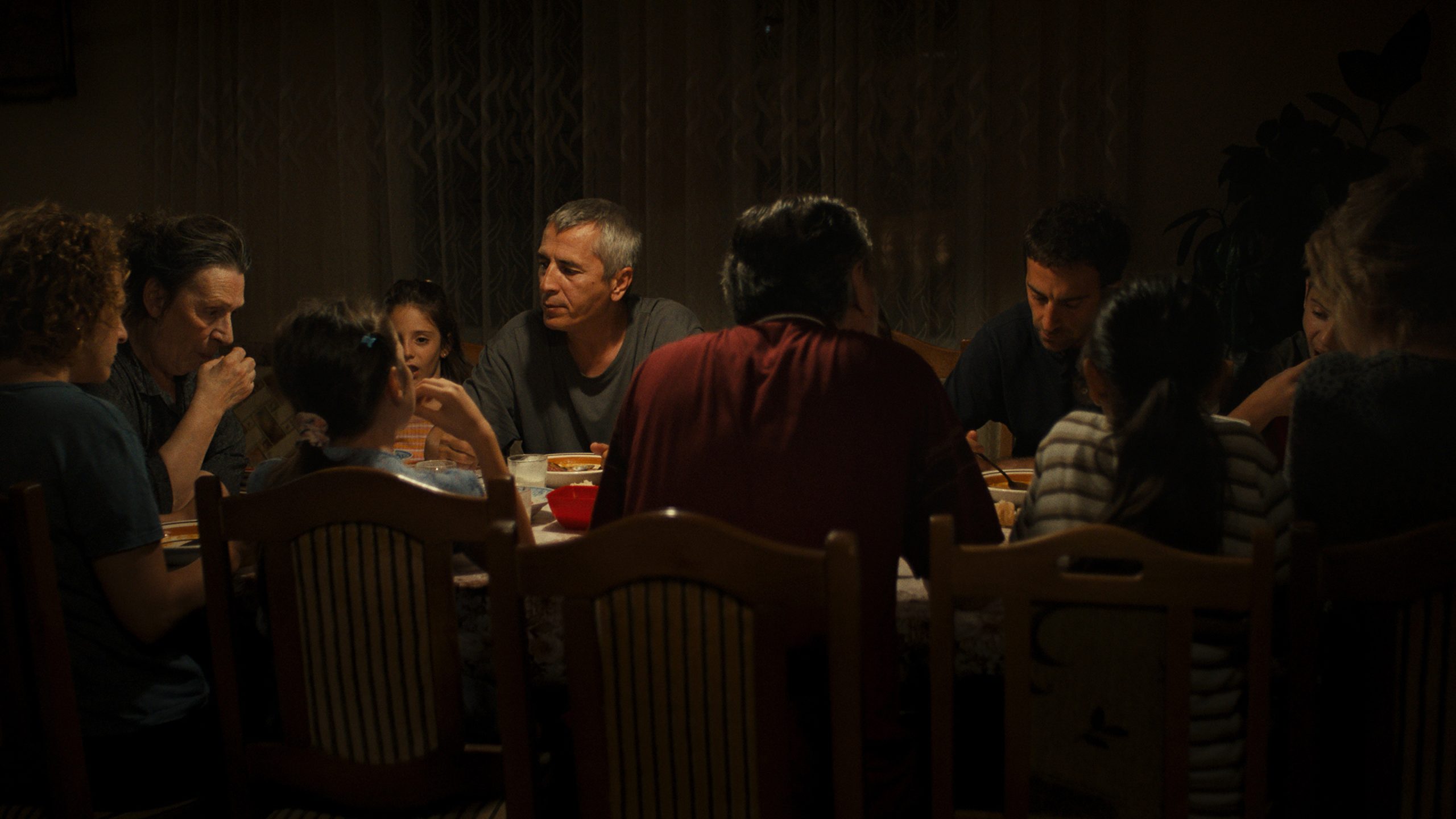
However, in Kosovo—a tiny independent republic, not quite East or West, and still haunted by a devastating war in the 1990s—Liridon, the one who contributes the least to the farm’s operation, is considered a fool by his brothers. His relatively brief presence in the film emanates a lack of seriousness, encouraging distrust. To his family, which lives on their mother’s pension, one brother’s wages as a teacher in the village, and the sale and barter of the farm’s milk and cheese, the small fortune Liridon wants to bet on himself is basically equivalent to the nest egg that supports them all, an extended family of ten. The tenuousness of their rural idyll is masked by the farm’s appearance of homey comfort. Their house appears spacious, well-furnished, and there’s no shortage of food.
But Morina makes clear that this warm equilibrium can only be maintained through the diligent and endless physical toil of the oldest brother, Shaban (Astrit Kabashi) and his wife Tixhe (Flonja Kodheli). Cinematographer Janis Mazuch’s camera stays close on Shaban at work, creating an intimacy with his physicality as he performs tasks whose purpose and necessity seem obvious to Shaban, who grew up in this world, but may remain a mystery to us city folk sitting in the dark observing him. The message is clear: persistent labor sustains; care for the well-being of the family and its animals provides the comfort and security of a home.
Are these people happy? Do they experience joy? Shaban’s three girls laugh and play well together. The family mostly enjoys each other’s company. Everyone sits at the table for dinner. Do they have hope for the future? This may be a question Liridon asks himself. It’s most certainly a question from the place he needs a loan to get to—a very different world, more concerned with getting ahead in life, ahead of others, than this one.
A sudden and unexpected turnaround puts Shaban, Tixhe, their children, and their mother on a bus to Pristina, the capital, looking for work and now dependent on the help of Tixhe’s sister, Lina, and her husband, Alban, a scion of a wealthy family. Weirdly mirroring Shaban’s rural world, Alban and Lina’s household includes his parents, his massive, mute, and motionless invalid father, contributing to the alien quality of the angular modernist home, confining and cold in its maze-like construction compared to the openness of the farm.
Alban arranges for an apartment for the family and gives Shaban and Tixhe a job cleaning up the club he owns, but fulfilling the family’s basic needs—food, shelter, clothing, and a fundamental dignity—requires more, more money as well as the possibility of being seen and heard. We know from those opening scenes of Shaban laboring on the farm, that he’ll do whatever it takes to give his family a good life, and that a good life for them does not require many amenities—even as his girls become enchanted by the eternal presence of a loaner TV and the lifestyles celebrated by the blaring, always-on music videos overwhelming more intimate discussion. In the city, where money is the final determinant of one’s wholeness, of one’s presence and mattering, it’s inevitable that Shaban’s earnest methods and mannerisms, his basic sense of honor, will be misunderstood, belittled, and dismissed.
Like Morina’s excellent 2020 Sundance feature Exil, whose subject was xenophobia, Shame and Money is a terse and humane fish out of water tale, relentlessly documenting the overwhelming fury engendered by being made to feel “not,” as Shaban comes to say, from being flattened into a devastating state of abstraction—a tool, an object—by the psychic and sometimes physical violence of an urban milieu that depends on uncomplaining cheap labor to sustain its flight towards a prosperous Western-style future. Excellent performances throughout the cast, an intelligent and often transparent script from Morina and cowriter Doruntina Basha, as well as some well-timed turns to visual metaphor, make Shame and Money a deeply resonant drama of forced transition and unsettling adaptation.
Since it premiered, Shame and Money won the World Cinema Dramatic Competition at the 2026 Sundnace Film Festival. Screenings have concluded.
More from Michael Mejia: Jaripeo Rides Into a New Vision of Mexican Manhood
Read more of our Sundance festival stories and enjoy all of our Arts and Culture coverage. And while you’re here, subscribe to our print magazine and get 6 copies of Salt Lake magazine each year.