
It was a slightly overcast late-November afternoon as I neared the trail’s last saddle before the summit, which loomed above me to the left. My husband, Dave, followed while Bella, our border collie mix, trotted ahead. When Bella abruptly stopped and looked down, her ears pointing skyward at full attention, I assumed she’d spotted a jackrabbit on a sage-covered hillside below. But when I joined her, my body pitched back almost involuntarily as I yelped “come!” and grabbed her collar to draw her away from the bottomless abyss that yawned out just under her nose.
That moment unfolded on Notch Peak, a mind-blowing monolith rising in the isolated House Mountain Range, nestled deep in central Utah’s West Desert. At 9,658 feet, the Notch Summit is not the range’s highest; that distinction belongs to the nearby 9,669-foot-high Swasey Peak. But the drop I pulled Bella away from plummets more than 2,500 feet to the ground; the only bigger drop in the U.S. is the face of El Capitan in Yosemite National Park. The Notch Peak Trailhead is off Highway 50 and 6, also known as the “Loneliest Road in America,” and the singular paved road bisecting the West Desert wilderness between Delta, Utah and the Nevada state line. But one person’s loneliness is another’s solitude and out there, against a backdrop of desert playas, isolated mountain ranges and sweeping sagebrush lowlands, multiple adventures await—from rambling through the desert on an ATV and hoofing it to Notch Peak to scaling ochre-hued desert cliffs and digging for fossils. No timed entry, no waiting for a parking spot at a crowded trailhead lot and no jockeying for a camp spot required.
Dust and Distance
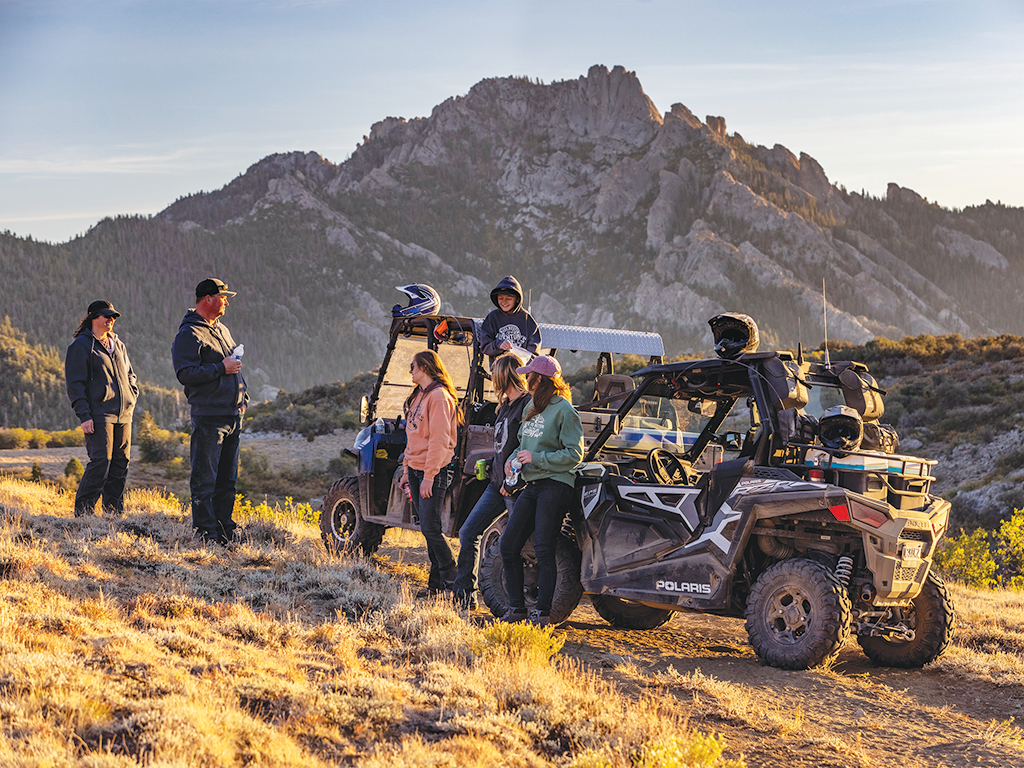
We reached Delta, population 3,675, and Millard County’s largest city, enroute to Notch Peak after a two-hour drive from Salt Lake (134 miles), exiting Interstate 15 at Nephi and making our way through open range, farmland and the tiny towns of Leamington and Lynndyl. With hotels, restaurants, two grocery stores and even a few bars, Delta is an apt launchpad for exploring the untamed slice of the greater Basin and Range Province west of town. There, hundreds of miles of dirt roads and tracks peel off Highway 50 & 6, drawing ATV/UTV riders from across Utah and beyond. Motorized trail networks recommended by Rachel West, tourism director for Millard County, include the 33 well-marked miles, rated easy to very difficult, within Amasa (pronounced ah-ma-see) Basin. Slightly farther west, the almost endless Conger Mountain OHV Trail System spans 127 miles along dirt rated easy to extreme.
Soon, Millard County could become home to the longest section of the High Desert Trail, a proposed 800-mile off-road route running from Snowville to just outside St. George. Carly Lansche, with the Utah Office of Outdoor Recreation, explained that the High Desert Trail will be created using existing county-maintained dirt roads and trails. “The only new construction along the route would be installation of educational and interpretive signage, along with bathrooms and staging areas,” Lansche says. The project is currently in the environmental assessment phase and will be followed by a public comment period, likely to be held later this spring.
Vastness, Earned
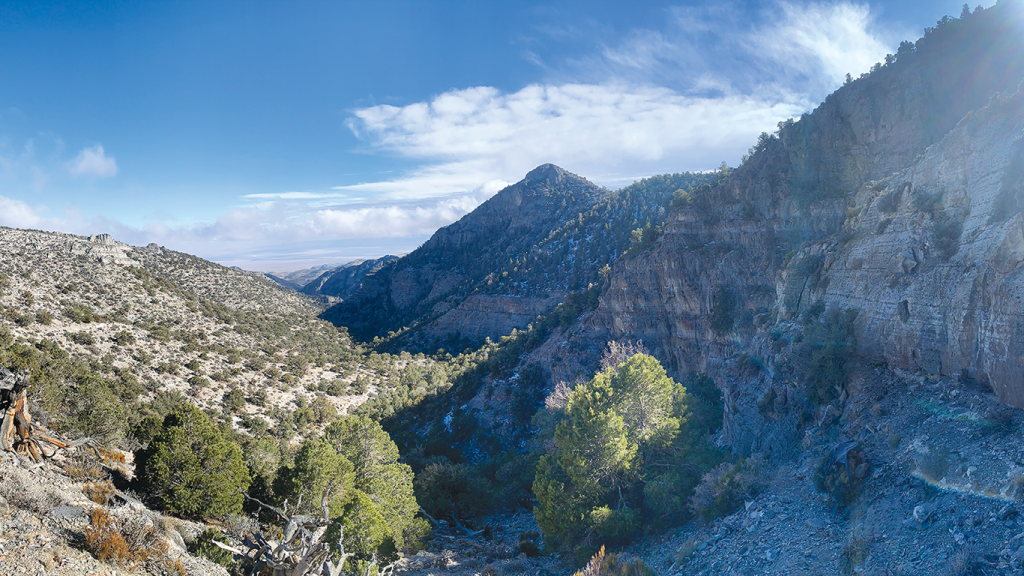
Not all West Desert exploration takes a full gas tank, however. The hike to Notch Peak is an absolute must-do and, at 7 miles round-trip with a 2,700-foot elevation gain, would be considered a moderately strenuous endeavor—if it wasn’t so remote and hard to get to. Arriving at the trailhead is the first challenge: take Hwy 50 & 6 west from Delta for 36 miles to a right turn onto the unpaved Notch Peak Loop Road. Continue 4 miles north, turning left on Miller Canyon Road. In another five miles, you’ll arrive at a BLM picnic area with pit toilets. Follow the signs from there to Sawtooth Canyon but be forewarned: the so-called “road” is very rough from the picnic area to the beginning of the hike, suitable for four-wheel drive, high clearance vehicles only. When you pass an old stone miner’s cabin, you are a mile from the signed trail head.
The trail begins by meandering past towering fractured-limestone walls, and then steepens as it passes through clusters of Bristlecone pines. A brief scrambling section precedes a sagebrush flanked drainage to the edge of the saddle. The steep (and loose) route to the summit is looker’s left of the saddle. As described at the beginning of this story, peering over the edge at the saddle or from the peak is no joke. I am not height-adverse, but I felt dizzy looking into that bottomless void and understood why Notch Peak is a favored base jumping launch.
Rock the Playa
Due south of Notch Peak, the West Desert takes an austerely surreal turn at Ibex, where stunning ochre and gray quartzite cliffs and boulders flank a sweeping lake bed, called the Tule Valley Hardpan. Hundreds of sport and traditional rock climbing routes are stacked along the cliffs, while bouldering routes pepper each of the enormous rocks strewn along the lake bed’s edge. James Garrett established much of the climbing there, and in 2010 published what is still considered the definitive guidebook to West Desert climbing and non-motorized adventuring, titled, appropriately, Utah’s West Desert. But even if you’re not a climber, driving out onto the hardpan is an experience—the stargazing there is unreal. And if you are wondering if Notch Peak’s soaring north-facing vertical wall, easily viewed from the hardpan, ever gets climbed, indeed it does. Routes there, which are each as long as climbing six skyscrapers, include the 12-pitch Western Hardman (Trad, 5.10c) and Book of Saturday (Trad and Sport, 5.11a).
More Desert Things To Do
As hinted at by the Tule Valley Hardpan, prehistoric Lake Bonneville once covered the landscape there, as well as the rest of Utah, Nevada and Idaho. As the waters receded, remains of countless marine arthropods called trilobites were left behind. The West Desert holds a treasure trove of these fossilized beetle-like creatures, and at U-dig Fossils, rockhounds of all ages can use a pickaxe to pound out these fascinating relics.
A curious roadside attraction near the trilobite quarry is the Hermit’s Cave Cabin, a rock structure built into a cliffside by Delta native Bob Stinson, who lived alone in his cave cabin for more than 20 years and where his ashes were scattered after his death. The cave cabin is in Marjum Pass along Old Highway 6.
Despite the harsh existence this spare landscape would seem to provide, the West Desert supports a variety of flora and fauna, including ancient Great Basin Bristlecone Pines, peregrine falcons, bighorn sheep, coyotes, Sage Grouse and more. A herd of 60 to 100 wild horses roams the area as well, mostly within the Swasey Mountain Horse Management Area, near the U-Dig Fossils quarry. Evening and morning are the best times for wild horse viewing, when the herd gathers at the HMA’s Middle Pond to drink. When you go, don’t forget to bring binoculars; wild horses are very wary of people and should be observed at a distance.
Back in Town
Standing side by side on Delta’s Main Street are two repositories for different chapters in the area’s storied past: the Great Basin Museum and the Topaz Museum. Exhibits within the former include some of the oldest fossilized rocks in Utah, artifacts from the Great Basin’s once-thriving Fremont Native American tribe, and interactive displays offering a glimpse into Delta’s pioneer era. Next door, the Topaz Museum is a curated telling of the World War II Topaz Japanese American incarceration site (located 16 miles northwest of Delta), sharing the stories, artifacts and experiences of the more than 11,000 people who were unjustly confined there from 1942 to 1945.
Eat and Sleep
Farm-to-table is not just marketing-speak at Ashton’s Burger Barn, the beef used in the burgers served there is raised on the pasturelands around town. Delta also has several Mexican restaurants, including Mi Rancherito, one of the town’s few eateries open on Sundays. And for adult fun, head to Curley’s Lounge, where live music plays most weekend nights and pool is free on Mondays and Tuesdays. Dispersed camping is allowed on the West Desert’s BLM lands. Be sure to bring all the water you’ll need and practice Leave No Trace principles. Rentals in Delta are available through Airbnb and VRBO. The Days Inn is a reliable hotel in Delta.
Delta’s West Desert is an off-the-grid adventure paradise. But one that requires respect and preparation. There is no cell service, no water and few people. When you venture, be sure to have a full gas tank, extra food, water, extra clothing and an emergency communication device, like a Garmin inReach. And while camping is popular on the Tule Hardpan at Ibex, a rainstorm can make the wet playa impassable. The trade-off for the leap of faith the West Desert requires is huge: a rare chance to step away from digital noise, hear your own thoughts and feel connected to the world around you.
Get the latest on Adventures in and around Utah. And while you’re here, subscribe and get six issues of Salt Lake magazine, your curated guide to the best of life in Utah.