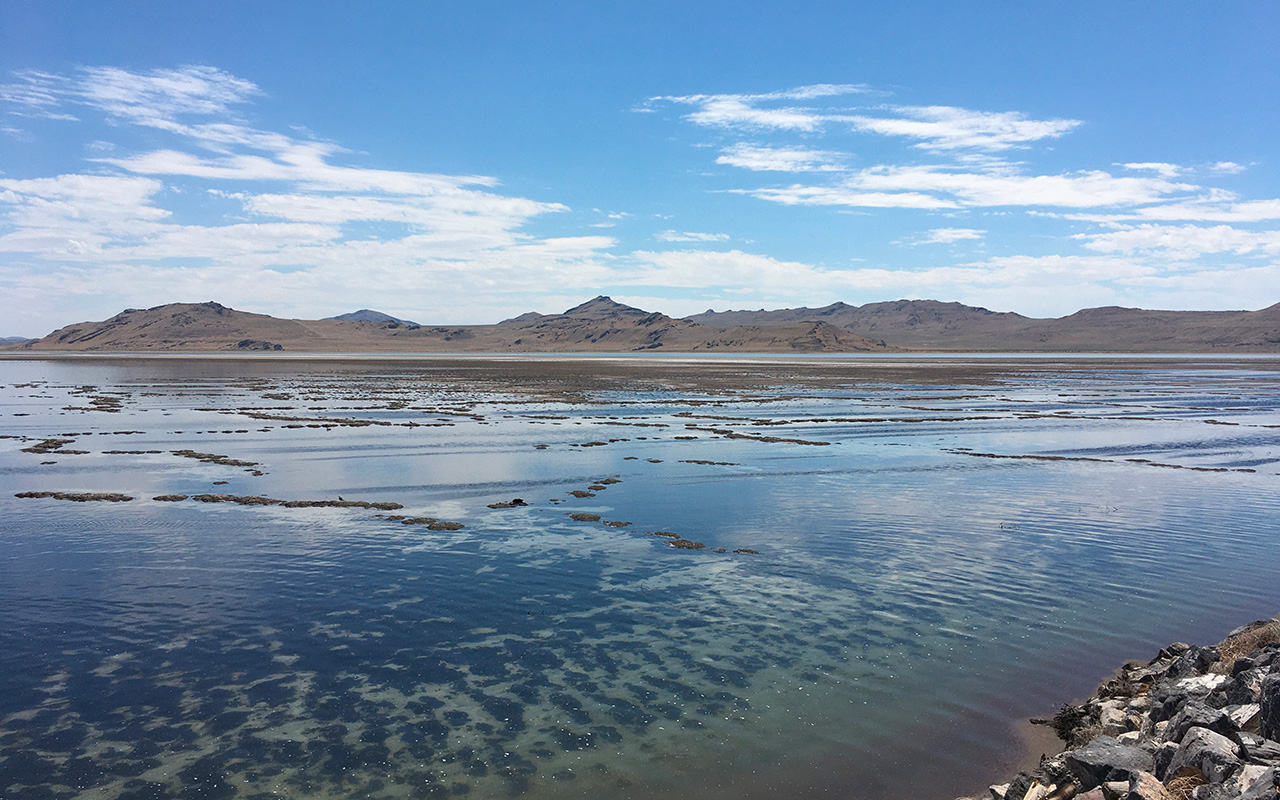
Like birds that land there in spring and summer, concern about data center development in Utah and how it could affect the drying Great Salt Lake is migrating south.
The focus is extending from the lake’s northern tip near the massive proposed Stratos project to its southern shore, near the site where developers are planning a warehouse hub for a data center, along with shipping and manufacturing facilities about 20 miles west of Salt Lake City.
Opponents of the plan on Monday raised concerns it could contaminate and further deplete the lake, harming migratory birds and public health as dust containing heavy metals rises from the exposed lakebed. For two hours, they urged state water managers to reject an application from developers to proceed with one part of the bigger Tooele Valley Public Infrastructure District project — a plan to discharge concentrated wastewater brine from a new well.
More than 100 people filled a room at the Utah Division of Water Resources’ office in Salt Lake City on Monday, with some holding colorful signs saying “No data centers” and cheering when others took the microphone to condemn the project just off I-80. A manager for the district did not provide immediate comment in response to a request from Utah News Dispatch on Monday.
“We are being asked to accept industrial pollution in one of Utah’s most fragile ecosystems, during one of the most prolonged droughts in our state’s history,” Terri Durfee told officials with the division.
Durfee lives on a road cutting through the Tooele Valley Public Infrastructure District, estimating her home is three miles from the planned development. She said she’s worried about the makeup of the wastewater and anything that could further squeeze the strained water supply.
Candice Hasenyager, director of the Utah Division of Water Resources, listened and took notes throughout the hearing. She did not make a decision during Monday’s meeting.
At full buildout, developers for the Tooele project are seeking the division’s permission to discharge about 250,000 gallons of brine per day that would flow into wetlands and on to the Great Salt Lake’s Gilbert Bay. A notice the state posted in advance of the public hearing states the flow would be the product of a brackish groundwater treatment process, “in which toxicity is neither an existing concern nor likely to be present.”
Just two people spoke in favor of the plan at Monday’s hearing, including Tom Checketts, a real estate attorney specializing in water issues. He said it would send more water to the lake in a process that’s monitored and continually reviewed.
Checketts said it’s “what’s in the best interest of the Great Salt Lake,” before his comments were met with boos.
Others took the opportunity to call for government leaders to pump the brakes on artificial intelligence and data center development in general and consider the environment first.
Environmental advocates called Monday’s hearing a first test of Gov. Spencer Cox’s executive order in May directing state agencies to prioritize the lake, along with air quality, water quality, and transparency, in making decisions about data centers.
Deeda Seed with the Center for Biological Diversity warned the area already has an overallocated aquifer, and “here comes a project that’s going to make that situation much much worse.”
“This permit is the thing that starts the ball rolling, and frankly, right now, it’s the thing that can stop this ball from rolling,” she said.
The Tooele Valley Public Infrastructure District is intended to house data centers, warehouses, “light” manufacturing plants, a truck stop, restaurants and a hotel, according to the public notice.
The controversy comes as data center projects, long criticized for their water usage, are facing newer concerns about what’s in their wastewater. In Wyoming, the Cheyenne Board of Public Utilities linked the discovery of a rare bacteria in wastewater to a Meta data center construction site and terminated its discharge permit. Meta is appealing the citation.
Ben Hart, executive director of the Utah Inland Port Authority, said the authority’s involvement with the project has focused on transportation within a 600-acre portion of the project but hasn’t extended to its southern section planned to accommodate a data center. He noted the wastewater treatment plant could end up serving both areas.
Asked about the permit application before the state, Hart said, “our position would be, there are valid concerns and they need to take their time and make sure we get this right.”
This article was originally published by Utah News Dispatch. Read the entire story here.
See more stories like this and all of our City Watch coverage. And while you’re here, why not subscribe and get six annual issues of Salt Lake magazine’s curated guide to the best of life in Utah?