

During the 1990s, as a young executive at Zions Bank, Scott Anderson bristled at a market survey that asked consumers to personify the institution. The answer was cutting: “A middle-aged, white, balding man who drives a Cadillac and lives in a gated community.”
“That was not the bank I recognized and not one I’d want to work for,” he recalls. For Anderson, the lesson was clear: if Zions Bank was going to thrive, it needed to look more like the communities it served.
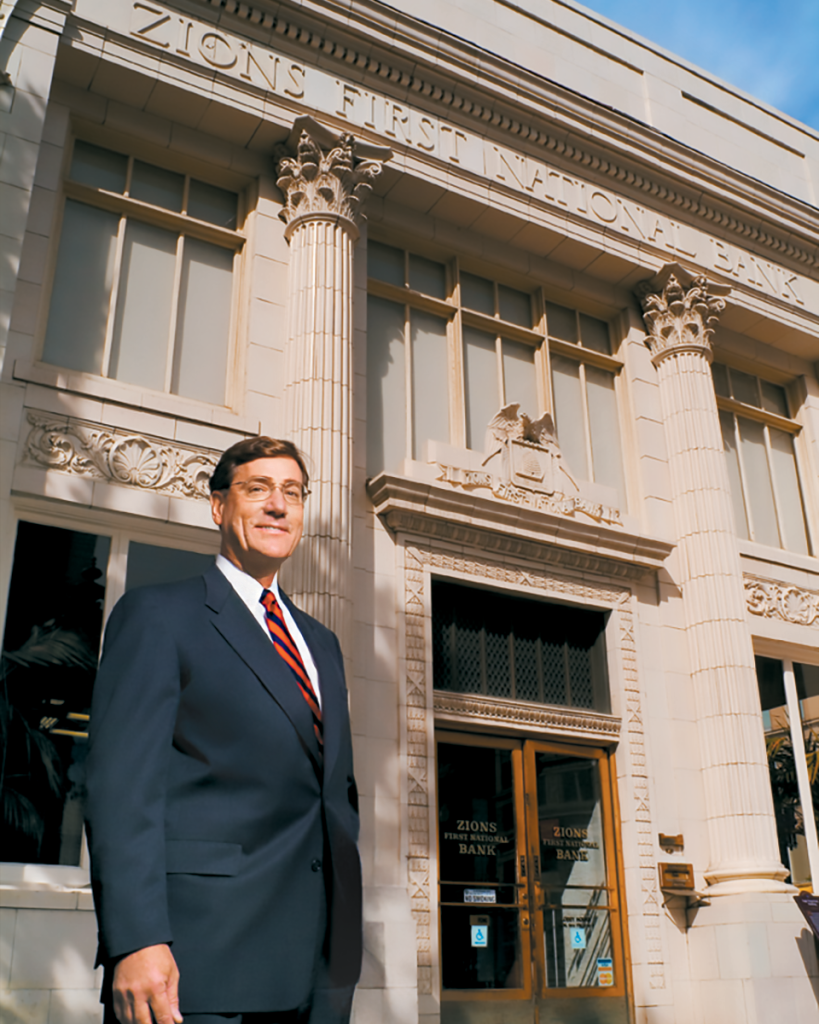
Less than a decade later, he became president and CEO. Though he’s quick to deflect praise, colleagues credit him with transforming the bank into Utah’s dominant commercial lender with a mammoth-sized community footprint to match. Under Scott’s direction, Zions backed causes that few expected from a buttoned-down banker: a racial equity compact, clean-air initiatives and the founding of groups like the National Women’s Leadership Institute and the Utah Hispanic Chamber of Commerce.
Though unassuming and egoless by reputation, Anderson became a kind of power broker anyway—mentoring politicians, advising governors and serving on more than 90 nonprofit boards. After 25 years at the helm, he retired last spring to a part-time chairman role. But in Salt Lake circles, he’s still known tongue-in-cheek as “Utah’s unelected governor”—a bridge-builder whose influence extends across race, religion, business and politics. We sat down with Scott to find out what he’s been up to over the last year, and what’s next.
A Conversation With Scott Anderson
How’s “retirement” going?
“As non-executive chair of Zions, I’m still engaged with the bank and the community. Retirement has actually given me the freedom to take on new opportunities and passions.”
What passions?
“I’ve joined new boards, including co-chairing (with David Cumming) the Great Salt Lake Alliance to ensure that the lake has a future and that it never dries up. I’m also involved with the Sutherland Institute and the City Strong Foundation. On a personal note, I’m passionate about growing food and I’m intrigued by soil—we have a little farm in Huntsville, and now I’m the proud owner of a tractor. We’ve harvested everything from tomatoes to pumpkins.”
Why step down as CEO of Zions Bank after 35 years?
“Gail Miller inspired me. She’d recently stepped down as chair of the Larry H.Miller Company.
She said, ‘Scott, it’s time to give other people a chance to lead and spread their wings,’ and I thought, ‘you know, she’s really right.’ She reminded me that leadership means giving others room to grow. My stepping down allowed Paul Burdiss, our new CEO, to bring fresh purpose and innovation. It’s been gratifying to see.”
You’ve also been a leader on climate and conservation.
“A lot of people have thought that the ‘left’ owns the environmental movement, that you can’t join it if you’re a conservative. People get caught up in the power of words, and the word ‘climate,’ like the words ‘diversity’ or ‘inclusion,’ has become politicized. I want to take politics out of our environment, because I think everyone should feel empowered to support conservation. We all deserve to breathe clean air or enjoy a healthy Great Salt Lake.
I think they are a mirror of our stewardship and our commitment to sustainability. I mean, if the lake dries up, nothing else matters—our economy, our community, our ecosystem. Stewardship and responsible growth can coexist if we work across party lines. That’s why I serve with bipartisan groups like the Hatch and Sutherland institutes.”
And your work on diversity, equity and inclusion?
“I really do believe that ‘All are created equal…endowed by a Creator with life, liberty and the pursuit of happiness.’ I think this is what makes our country great, but I believe America fulfills its promise only when everyone has access to education, housing, jobs and healthcare.
Utah, remarkably, still offers that mobility—highest household income (adjusted for cost of living), lowest poverty rate and a broad opportunity to join the middle class. That’s what an inclusive economy looks like, and I push every organization I join to pursue it.”
Advice for Utah’s next generation of leaders?
“I see what they’re accomplishing—this generation—and they seem to have a greater desire to give back. They want to be successful, of course, but they also really want to serve others. I see so many that are doing so much—from redesigning what Salt Lake will look like to helping raise those left behind.
My advice to this next generation would be: never stop dreaming, but also never stop working. You can’t make dreams your master; you have to be willing to take the risk involved to move forward. Don’t be afraid of change, and don’t be afraid to do what’s right.
Read more stories like this and all of our Community coverage. And while you’re here, subscribe and get six issues of Salt Lake Magazine, your curated guide to the best of life in Utah.